

Why Does Stamp Duty Self-Assessment Matter for Malaysian Businesses?
What happens if a contract your business signed is never stamped? As of 2026, Malaysia's stamp duty self-assessment steps apply to instruments covered by the current LHDN rollout phase; unstamped dutiable instruments are generally inadmissible in civil proceedings, but may be admitted on payment of the duty and any applicable penalty, and other statutory exceptions apply. The Inland Revenue Board (LHDN) requires the duty payer or an appointed agent to assess, submit and pay duty on those instruments through the Stamp Assessment and Payment System (STAMPS) via MyTax. Other dutiable instruments are being brought into self-assessment in later phases.
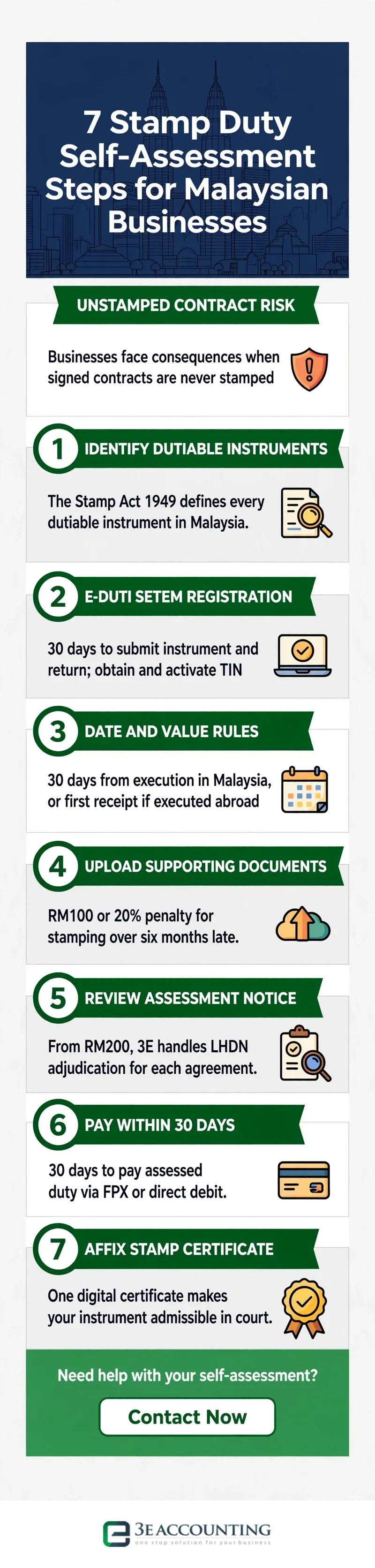
That responsibility sits with you, not with any third party by default. In this guide, we walk through seven practical steps — from identifying dutiable instruments to affixing your digital certificate — so your agreements avoid the evidential barrier and reduce the risk of late-stamping penalties.
Which Legal Instruments Are Dutiable?
The Stamp Act 1949 lists every instrument that attracts stamp duty in Malaysia. Examine commercial contracts, tenancy agreements, loan documents and share transfer forms against its categories. Applicable duty rates and statutory deadlines depend on the instrument. Miss a dutiable document, and the penalty clock starts running without you.
How Do You Register for e-Duti Setem via MyTax?
Submit the instrument and return within 30 days of execution in Malaysia, and obtain a tax identification number and activate your MyTax account before filing; under self-assessment, payment and stamping are due within 30 days of the deemed assessment. Log in and select Perkhidmatan ezHasil, Duti Setem, then e-Duti Setem. Digital filing lets you retrieve records and check the status of applications without visiting a counter.
Why Are Transaction Dates and Values Important?
Submit instruments within 30 days of execution in Malaysia or first receipt in Malaysia if executed abroad; under self-assessment, payment and stamping are due within 30 days of the deemed assessment; accurate transaction dates and values are still vital when completing stamp duty self-assessment steps in Malaysia. They determine the statutory deadline and inform the ad valorem duty calculation. Within three months after the deadline, the standard penalty is RM50 or 10% of the deficient duty, whichever is higher. A wrong date or value invites penalties and time-consuming rework.
Upload Mandatory Supporting Documents
The standard penalty for stamping more than three months late is RM100 or 20% of the deficient duty, whichever is higher. The Collector may refuse an adjudication application until all supporting documents are furnished. Attach clean digital copies of the signed instrument, identification records and relevant transaction schedules. Incomplete uploads cause avoidable delays and rejections.
Stamping deadlines for instruments
| Where the instrument was executed | Stamping deadline |
|---|---|
| In Malaysia | Submit within 30 days of execution; under self-assessment, pay and stamp within 30 days of the deemed assessment |
| Outside Malaysia | Submit within 30 days after first receipt in Malaysia; under self-assessment, pay and stamp within 30 days of the deemed assessment |
Review Stamp Duty Assessment
The published processing fee for 3E's e-stamping service starts from RM200 per agreement. Subscription to 3E's annual secretarial service is required. Complete and submit the self-assessment return in e-Duti Setem, then review the resulting assessment and check the fixed or ad valorem duty payable. Correct any errors promptly to avoid penalties. This processing fee excludes the stamping fees themselves.
Execute Payment Through Approved Channels
Instruments executed in Malaysia should generally be submitted within 30 days of execution; under self-assessment, payment and stamping are due within 30 days of the deemed assessment. Pay promptly within the applicable deadline. MyTax's e-Duti Setem supports online payment through FPX and selected bank bill-payment facilities. Late-stamping penalties can exceed RM100 when the percentage-based amount is higher.
What Should You Do With Your Stamp Certificate?
Submit instruments within 30 days of execution in Malaysia or first receipt in Malaysia if executed abroad; under self-assessment, payment and stamping are due within 30 days of the deemed assessment; once LHDN confirms payment, one digital stamp certificate should be downloaded and attached to the original executed agreement. An unstamped dutiable instrument is generally inadmissible in civil proceedings, but may be admitted on payment of the duty and any applicable penalty, and other statutory exceptions apply. Stamping addresses this evidential barrier; it does not guarantee enforceability.
Ready to Get Your Agreements Stamped?
Our Corporate Professional Advisors handle e-Duti Setem adjudication, payment and certificate retrieval for you.
Frequently Asked Questions
For instruments covered by the applicable rollout phase, the duty payer or appointed agent assesses and submits the duty through e-Duti Setem on MyTax. Other categories are being brought into self-assessment in later phases.
Submit the instrument and return within 30 days of execution in Malaysia, or within 30 days of first receipt in Malaysia if executed abroad. Under self-assessment, payment and stamping are due within 30 days of the deemed assessment.
The standard penalty is RM50 or 10% of the deficient duty within three months after the deadline, or RM100 or 20% after three months, whichever is higher in each case. Eligible instruments may qualify for temporary penalty remission.
An unstamped dutiable instrument is generally inadmissible as evidence in civil proceedings. It may be stamped later upon payment of the duty and any applicable penalty, subject to other objections to admission.
3E provides an e-stamping service from RM200 processing fee per agreement, covering adjudication with LHDN, payment follow-through and guidance on stamp duty exemptions.

Abigail Yu
Director
Abigail Yu oversees executive leadership at 3E Accounting Group, leading operations, IT solutions, public relations, and digital marketing to drive business success. She holds an honors degree in Communication and New Media from the National University of Singapore and is highly skilled in crisis management, financial communication, and corporate communications.