
Discovering an EPF under-deduction after payday in Malaysia means starting a correction with the fund still short and the payroll records wrong. Quietly adjusting next month's payslip can turn that contribution error into an unlawful wage deduction.
In this article, we explain how to correct an EPF payroll shortfall in Malaysia. We cover payment, record corrections and the conditions for recovering the employee's share.
What Should You Check First After an EPF Under-Deduction?
Every correction starts with one statutory fact: the employer must remit both the employee's share and the employer's share of EPF, whatever went wrong with the payroll settings.
According to the Employees Provident Fund's employer guidance on mandatory contributions, the employer must remit both the employee's share and the employer's share of the contribution, and payment is due on or before the 15th day of the month following the wage month. That payment obligation to the fund is legally separate from any right to recover the employee's share from the employee — a distinction that governs the entire correction.
In our team's practice, under-deductions usually trace back to three causes: a stale rate override left in the payroll master after a statutory change, a wage base that treated an allowance or bonus incorrectly, or a new joiner missed from the contribution schedule. To make the mechanics concrete, consider a hypothetical employee below age 60 who earned exactly RM5,000 in EPF-liable wages for October 2026, with no other wage component.
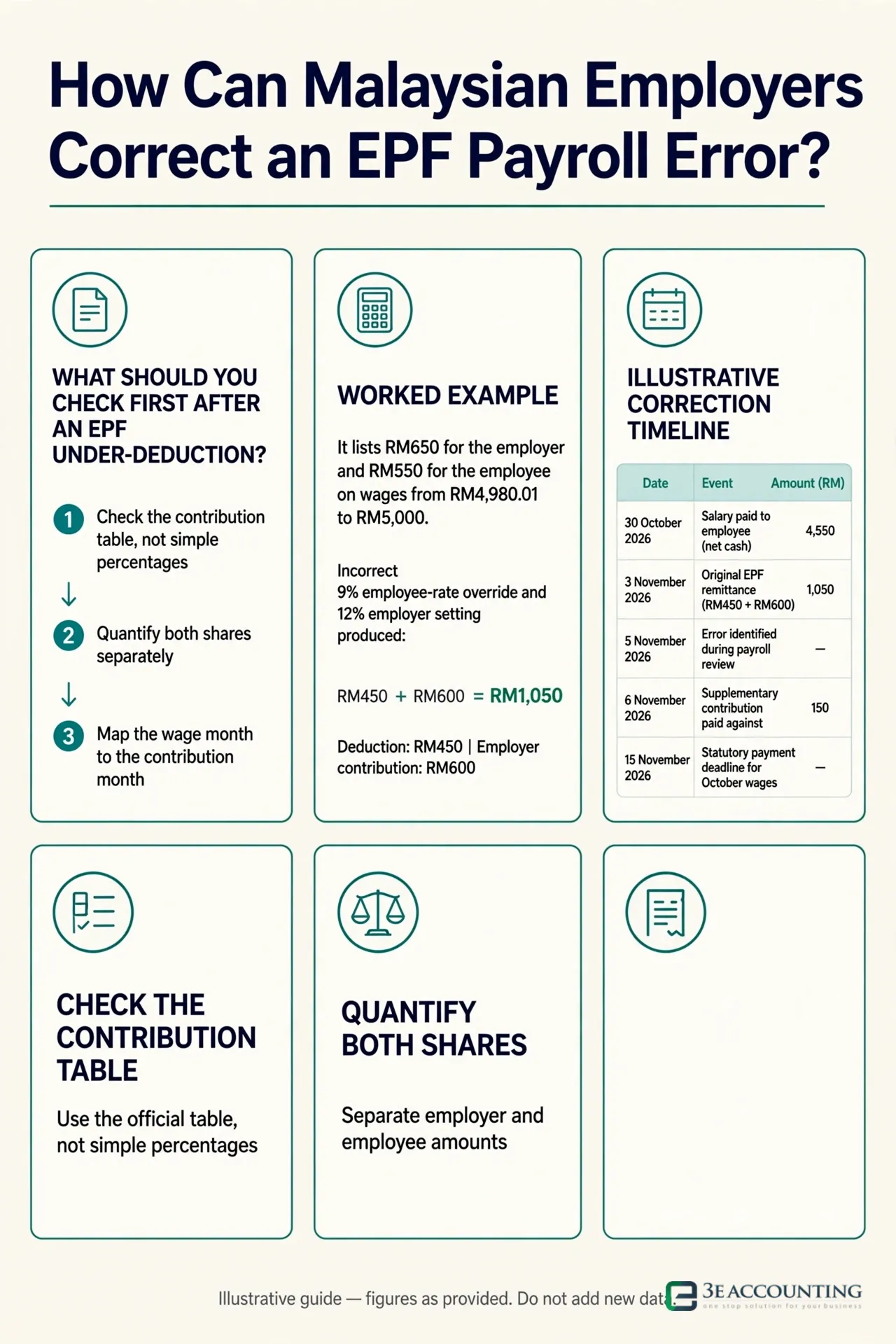
In this illustration, an outdated 9% employee-rate override and an incorrect 12% employer setting produced a deduction of RM450 and an employer contribution of RM600. The applicable contribution table set the correct amounts at RM550 and RM650, leaving shortfalls of RM100 and RM50 respectively. The example is deliberately simple; bundled SOCSO, EIS and PCB errors are corrected through their own processes and are not part of these figures.
1. Check the contribution table, not simple percentages
Check KWSP's Third Schedule for the applicable wage range and employee category. For this hypothetical employee, Part A of the schedule effective from 1 October 2025 applies. It lists RM650 for the employer and RM550 for the employee on wages from RM4,980.01 to RM5,000. Other wages or categories can produce different amounts. Confirm the applicable schedule and category when making a correction. KWSP permits exact percentage calculations for wages exceeding RM20,000, subject to its rounding rules.
2. Quantify both shares separately
A two-share reconciliation keeps two questions apart. The employee's RM100 shortfall is the only amount that even raises a recovery question. The employer's RM50 shortfall is the employer's own cost and can never be recovered from wages.
3. Map the wage month to the contribution month
October 2026 wages correspond to the November 2026 contribution month, with payment due on or before 15 November 2026. Before relying on any deadline, confirm the date and any weekend or public-holiday treatment with KWSP directly, as the applicable treatment should be checked at the time of the correction.
How Do You Correct the Records and Pay the Shortfall?
The correction follows a fixed sequence: preserve the original records, quantify the shortfall, pay it against the original wage month, post a correction journal, and keep evidence that proves allocation — not merely payment.
Our team's approach is to fix the fund's record first and treat employee recovery as a separate, later question. An employee's refusal to cooperate does not suspend the employer's contribution obligation. Assume the hypothetical RM1,050 remittance was paid on 3 November 2026. The error was found on 5 November, and RM150 was paid on 6 November. These dates and payments are assumptions, not verified transactions. Confirm any applicable charges with KWSP.
Step 1: Preserve the original records
Retain the original payroll register, payslip, Form A submission and payment receipt before changing anything. If a correction later needs to be explained to KWSP, the labour department or a tax reviewer, these contemporaneous records are what establish what was paid and when.
Step 2: Reconcile and pay the top-up against the correct month
For the hypothetical example, reconcile RM1,200 due against RM1,050 assumed paid. The resulting shortfall is RM150. Arrange payment for the affected employee and October wage period, not a later ordinary contribution. October wages correspond to the November contribution month. Confirm the submission route, contribution-month selection and allocation evidence with KWSP and the payroll reviewer. If the portal will not accept the correction, obtain KWSP's instructions rather than overwriting the original submission. For an overdue shortfall, arrange payment promptly and obtain KWSP's assessment of any late-payment charge and dividend. i-Akaun supports Form A submissions, contribution information and payment receipts.
Step 3: Post the correction journal
The original RM1,050 liability was already settled. The illustrative correction journal has three lines:
- Debit employer EPF expense RM50
- Debit employee-share correction expense RM100
- Credit EPF payable RM150
The payment entry then debits EPF payable and credits bank RM150. The employee-share expense reflects the hypothetical decision that the employer bears the shortfall. Review the entry and figures under the entity's applicable Malaysian reporting framework. This is not a universal posting instruction. It excludes consequential payroll and tax adjustments, which need separate review.
Step 4: Retain proof of allocation, not just proof of payment
A bank debit receipt alone does not establish that the top-up was allocated to the correct employee and wage period. Keep both submissions, both payment receipts, the correction journal, the supplementary statement, and confirmation from the employee's contribution record that the additional contribution has actually been allocated to October 2026. This is a suggested control, not a prescribed form of proof. Confirm with KWSP what allocation evidence it can provide.
Illustrative EPF Shortfall Reconciliation
| Share | Statutory amount (RM) | Amount paid (RM) | Shortfall (RM) |
|---|---|---|---|
| Employee share | 550 | 450 | 100 |
| Employer share | 650 | 600 | 50 |
| Total | 1,200 | 1,050 | 150 |
Can You Recover the EPF Shortfall from the Employee's Salary?
Recovery is conditional, not automatic — and in the hypothetical example the employer decided to fund the RM100 employee shortfall rather than risk an unlawful wage deduction.
Do not deduct the hypothetical RM100 from the next salary simply because it was the employee's share. Check the EPF Act 1991 recovery rules first. For covered employees, also check the Employment Act 1955 wage-deduction restrictions.
1. What the EPF Act 1991 permits
Section 47 prohibits the employer from recovering its own contribution from the employee's wages or remuneration — the employer's RM50 shortfall is simply the employer's cost. Section 48 ordinarily ties recovery of the employee's share to the wages of the period concerned. Its exception allows later recovery only in prescribed conditions:
- an omission through error not occasioned by employer negligence
- recovery within six months of the payment of those wages
- any conditions the EPF Board prescribes
A stale payroll setting is not automatically a non-negligent error. Its classification depends on the documented facts. Ask counsel to check the Board conditions and applicable wage-deduction law. Where eligibility is doubtful, obtain KWSP's written position before deducting anything.
2. What the Employment Act 1955 adds
Section 24 of the Employment Act 1955 restricts deductions from wages, while permitting deductions authorised by other written law. It provides routes based on an employee's written request and, for specified deductions, the Director General of Labour's permission. It also sets an ordinary ceiling of 50% of the month's earned wages on aggregate deductions, subject to statutory exceptions. Employee consent is not a general licence to make any deduction. Nor is an EPF under-deduction automatically a recoverable wage overpayment. The separate mistaken-overpayment provision covers overpayments made during the immediately preceding three months. Counsel should resolve how it interacts with the EPF Act on the facts. Consent or permission routes must not be presented as overriding the EPF Act's recovery restrictions.
3. Territorial scope and the 2022 amendments
The Employment (Amendment) Act 2022 took effect on 1 January 2023 and expanded employee coverage in Peninsular Malaysia and Labuan, subject to statutory exceptions. It did not introduce a consent-based right to recover an old EPF shortfall. This analysis applies to Peninsular Malaysia and Labuan; employers in Sabah and Sarawak should check their separate labour legislation before acting.
Illustrative Correction Timeline
| Date | Event | Amount (RM) |
|---|---|---|
| 30 October 2026 | Salary paid to employee (net cash) | 4,550 |
| 3 November 2026 | Original EPF remittance (RM450 + RM600) | 1,050 |
| 5 November 2026 | Error identified during payroll review | — |
| 6 November 2026 | Supplementary contribution paid against October 2026 | 150 |
| 15 November 2026 | Statutory payment deadline for October wages | — |
How Should the Payslip and Payroll Ledger Be Corrected?
Fix the records with a clearly labelled supplementary statement and a transparent journal — never by quietly netting the shortfall off next month's pay.
The payroll ledger and the payslip must both reflect the truth of October 2026: the correct contribution, what was actually deducted, and who funded the difference. A supplementary statement does that without disguising the error, and it protects the employer if the correction is ever queried by KWSP, the labour department or the employee.
1. What the supplementary statement should show
In the illustration, the statement records that the original cash salary remains RM4,550 (assuming no other deductions were made from salary), the correct employee contribution is RM550, RM450 was deducted, and RM100 was funded by the employer without any further wage deduction. The statement is labelled supplementary and illustrative in nature — its figures and wording should be confirmed against the actual records before use in a real case.
2. Acknowledgement is not consent
If the employee signs an acknowledgement of receipt, that signature must not be represented as consent to a deduction or a waiver of any rights. Any proposed recovery from future wages needs separate legal review against the EPF Act and, where applicable, the Employment Act, regardless of what the employee signs.
3. Fix the master rate for future payroll
Correcting the payroll master rate prevents the error from recurring, but it does not repair October's submission and it does not create a right to recover October's shortfall. The October correction and the forward-looking fix are two different jobs, and both must be done.
Illustrative Correction Journal Entries
| Account | Debit (RM) | Credit (RM) |
|---|---|---|
| Employer EPF expense (employer shortfall) | 50 | |
| Employee-share correction expense | 100 | |
| EPF payable | 150 | |
| EPF payable (on payment) | 150 | |
| Bank | 150 |
Employee Recovery Routes and Their Limits
| Route | Key condition | Employer takeaway |
|---|---|---|
| EPF Act 1991, section 48 | Recovery ordinarily tied to the wages of the contribution period | Do not deduct from a later salary by default |
| Section 48 exception | Error not occasioned by employer negligence, within six months, Board-prescribed conditions | Confirm eligibility with KWSP before acting |
| Employment Act 1955, section 24 | Deductions must be authorised by written law, written request, or DG permission; ordinary 50% aggregate cap | Consent alone is not authorisation |
| Section 24 mistaken overpayment | Covers wage overpayments in the immediately preceding three months | An EPF under-deduction is not automatically a recoverable overpayment |
When Should You Escalate an EPF Payroll Correction?
Escalate when the employee disputes the correction, more than one month is affected, the employee has resigned, or KWSP's allocation of the top-up cannot be verified.
A single-month, single-employee correction with a cooperative employee can usually be closed quickly. Suggested escalation triggers include:
- A dispute about the error, its cause, or any proposed recovery
- Multiple affected months or employees, which signals a systemic setting problem
- A resigned or departing employee, where recovery becomes far harder
- KWSP allocation queries that cannot be resolved through i-Akaun
- Any decision for the employer to absorb the employee share
An employer-funded employee share raises separate review questions:
- Is it taxable remuneration?
- What are the PCB and reporting consequences?
- Is it deductible for the employer?
- Are EPF relief or further EPF contributions affected? These outcomes depend on the facts, so obtain a tax review rather than assuming a definitive treatment. A payroll and tax review can address these questions alongside bookkeeping services and monthly payroll processing. Even multinational companies in Malaysia with dedicated HR functions encounter stale payroll settings after statutory rate changes, so the risk is not confined to small teams. Where any of these triggers applies, contact us for a review before money moves.
Conclusion
Correct an EPF under-deduction by checking both shares against the applicable table. Arrange payment for the affected period and verify its allocation. Post a transparent correction journal. Pay an overdue shortfall promptly and obtain KWSP's assessment of any charges. Employee recovery is a separate, conditional legal question. If the employer bears the employee share, review the tax and payroll consequences.
As a Corporate Services Provider, 3E Accounting Malaysia supports employers with monthly payroll processing, statutory submissions to KWSP, EPF, SOCSO and LHDN, and the record-keeping that makes corrections defensible. Where a correction involves disputes, multiple months or a tax review of an employer-borne shortfall, our Corporate Professional Advisors can help you get it right the first time.
Need Help Fixing an EPF Payroll Error?
Our Corporate Professional Advisors can review your payroll records, quantify the shortfall, and manage the correction and statutory submissions with KWSP on your behalf.
Frequently Asked Questions
Not automatically. Under the EPF Act 1991, recovery of an omitted employee share is ordinarily tied to the wages of the contribution period, and the exception for later recovery is conditional on factors such as the error not being attributable to employer negligence and a six-month window. A written consent from the employee does not by itself make the deduction lawful.
The employer does. KWSP assesses late-payment charges and dividend on overdue contributions, and these amounts should never be deducted from the employee's wages. Obtain KWSP's own assessment rather than estimating a penalty figure.
No. A payment receipt proves money left your bank account, not that it was allocated to the correct employee and wage month. Always confirm the allocation in the employee's contribution record through i-Akaun or obtain KWSP's written confirmation.
Not automatically. The Employment Act 1955 has a separate provision for mistaken wage overpayments during the immediately preceding three months. An EPF under-deduction should not automatically be treated as a recoverable overpayment. Counsel should assess the interaction with EPF recovery rules on the facts.
The employer's obligation to correct the fund's record continues regardless of the employee's status, so the shortfall should still be quantified and paid. Recovering the employee share from a former employee is significantly harder and should be escalated for legal review before any demand is made.

Abigail Yu
Director
Abigail Yu oversees executive leadership at 3E Accounting Group, leading operations, IT solutions, public relations, and digital marketing to drive business success. She holds an honors degree in Communication and New Media from the National University of Singapore and is highly skilled in crisis management, financial communication, and corporate communications.