What Are the Mandatory e-Invoice Document Types in Malaysia Businesses Must Master?
Has your company reviewed its financial exposure ahead of the latest national tax automation roadmap? On 30 August 2026, the Inland Revenue Board of Malaysia (LHDN) revised the mandatory compliance rules. In this guide, we break down the 6 critical e-invoice categories Malaysia businesses must master in 2026.
Effective 1 September 2026, businesses with annual turnover or revenue below RM3 million that meet LHDN’s exemption criteria are exempt, while other taxpayers must follow their applicable e-Invoice implementation date. Taxpayers may submit e-Invoices through the MyInvois Portal or an API, subject to their applicable e-Invoice obligations. When handling annual regulatory reviews alongside your company secretary services in Malaysia, operational readiness protects your corporate standing. Connect with 3E Accounting Malaysia to evaluate your digital readiness and support reliable tax compliance today.
What Are Standard Sales Invoices?
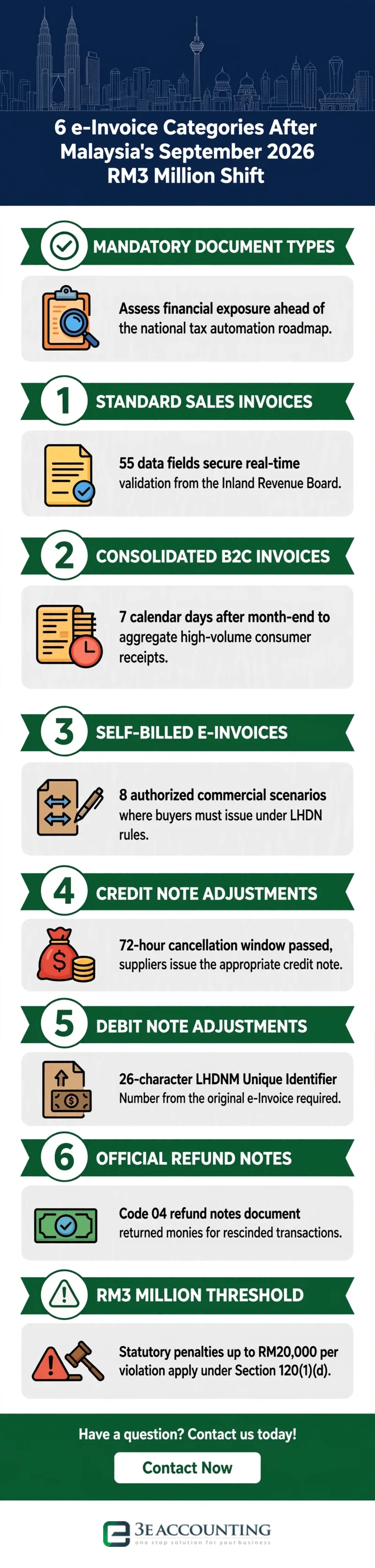
Suppliers must transmit 55 data fields to obtain real-time validation from the Inland Revenue Board of Malaysia. This standard document records commercial sales across domestic business-to-business (B2B) and business-to-government (B2G) transactions. LHDN validates each submission instantly through its MyInvois portal before assigning a unique digital identifier. A validated e-Invoice can serve as a buyer’s proof of expense, while existing documentation remains acceptable for tax deductions until legislation is amended.
What Are Consolidated B2C Invoices?
Retailers have 7 calendar days after month-end to aggregate high-volume consumer receipts into a consolidated e-invoice. This category allows consumer-facing businesses to combine individual retail receipts where retail buyers do not request validated invoices. Outside the interim relaxation period, suppliers must issue an individual e-Invoice for any single transaction exceeding RM10,000; eligible taxpayers may issue consolidated e-Invoices during the relaxation period ending 31 December 2027. Proper monthly consolidation prevents administrative backlogs while maintaining complete regulatory compliance.
What Are Self-Billed e-Invoices?
Buyers must issue self-billed e-invoices across 8 authorized commercial scenarios specified under official LHDN rules. Common use cases include foreign supplier imports, agent commissions, corporate dividend distributions, and licensed betting payouts. In these situations, the buyer assumes responsibility for generating the tax document instead of the supplier. Correct self-billing provides the buyer with a validated e-Invoice as proof of expense for tax purposes.
Credit Note Adjustments
Where an adjustment is needed after the 72-hour cancellation window, suppliers must issue the appropriate credit note, debit note or refund note e-Invoice. This adjustment document formally corrects billing errors, applies commercial discounts, or accounts for returned merchandise. The credit note reduces original invoice values without triggering audit discrepancies across corporate tax submissions. Every digital credit note must reference the original invoice's unique identifier. This correction workflow belongs to the e-invoice categories Malaysia businesses must follow.
2026 Malaysia e-Invoice Category Checklist
| e-Invoice Category | Key Requirement | Validation or Deadline |
|---|---|---|
| Standard Sales Invoices | Mandatory and applicable conditional fields for B2B/B2G sales | Near-real-time IRBM validation |
| Consolidated B2C Invoices | Monthly aggregate of consumer receipts; individual e-invoice above RM10,000 | 7 calendar days after month-end |
| Self-Billed e-Invoices | Buyer issues across 8 authorised scenarios | Buyer-generated digital document |
| Credit Note Adjustments | Corrects errors, discounts and returns after cancellation window | References original invoice unique identifier |
| Debit Note Adjustments | Post-billing cost increases and underbilled items | 36-character UUID required |
| Official Refund Notes | Documents returned funds for rescinded transactions | Code 04 refund note |
Debit Note Adjustments
Businesses must include the original e-Invoice’s 26-character LHDNM Unique Identifier Number and the original internal e-Invoice code or number when issuing an e-debit note. Debit notes document post-billing cost increases, including unexpected delivery surcharges, material price shifts, or underbilled items. Registered entities can verify registration status via the Companies Commission of Malaysia (SSM) portal before issuing debit adjustments. Real-time validation ensures both parties maintain synchronized accounts for statutory tax filing.
Official Refund Notes
LHDN designates code 04 specifically for official refund notes that document commercial repayments to buyers. Unlike credit notes that merely reduce account balances, refund notes confirm an actual return of funds. Merchants issue this document when customer agreements are terminated or damaged goods require full monetary restitution. Accurate validation creates a verifiable audit trail for tax authorities.
RM3 Million Threshold Readiness
Businesses face statutory penalties up to RM20,000 per violation under Section 120(1)(d). The Income Tax Act 1967 treats every unvalidated commercial transaction as an individual non-compliance offence. Company directors should monitor sdn bhd statutory filing dates 2026 while updating enterprise resource planning (ERP) configurations before September 2026. Ensuring total transaction accuracy across the e-invoice categories Malaysia mandates protects corporate entities in Malaysia from severe regulatory fines.
Need Assistance With E-Invoicing?
Speak with our Corporate Services Provider team to automate compliant billing before statutory deadlines.
Frequently Asked Questions
Effective 1 September 2026, LHDN exempts businesses with annual turnover or revenue below RM3 million only if they meet LHDN’s exemption criteria; other taxpayers must follow their applicable e-Invoice implementation date.
Businesses with annual revenue of RM3 million or more must implement compliant electronic invoicing systems by September 2026.
Yes, retailers may consolidate retail receipts monthly, except for individual transactions exceeding RM10,000.
Once the 72-hour cancellation window expires, businesses must issue digital credit notes or debit notes.
Section 120(1)(d) of the Income Tax Act 1967 imposes fines between RM200 and RM20,000 per violation.

Abigail Yu
Director
Abigail Yu oversees executive leadership at 3E Accounting Group, leading operations, IT solutions, public relations, and digital marketing to drive business success. She holds an honors degree in Communication and New Media from the National University of Singapore and is highly skilled in crisis management, financial communication, and corporate communications.