
Why Must Companies Comply with Beneficial Ownership Malaysia Rules?
Does your private limited company know who truly exercises control behind its corporate shareholding? Under the Companies Act 2016, the Companies Commission of Malaysia (SSM) now makes corporate transparency mandatory for every Sdn Bhd.
In this guide, we describe the six statutory tests required for a beneficial owner Sdn Bhd assessment, helping businesses satisfy beneficial ownership Malaysia compliance and prevent regulatory penalties.
The SSM Guideline for the Reporting Framework for Beneficial Ownership of Legal Persons (2024 revision, effective 1 April 2024) requires thorough verification of all individuals who ultimately own or control a company. Companies must update their internal register of beneficial owners within 14 days of receiving confirmed information. Before SSM’s January deadline, review these 6 shareholding update facts to keep your beneficial ownership register accurate and compliant. They must then lodge that information with SSM within 14 days after recording it. Contact our corporate secretarial team to prepare and lodge your beneficial ownership information before the deadline.
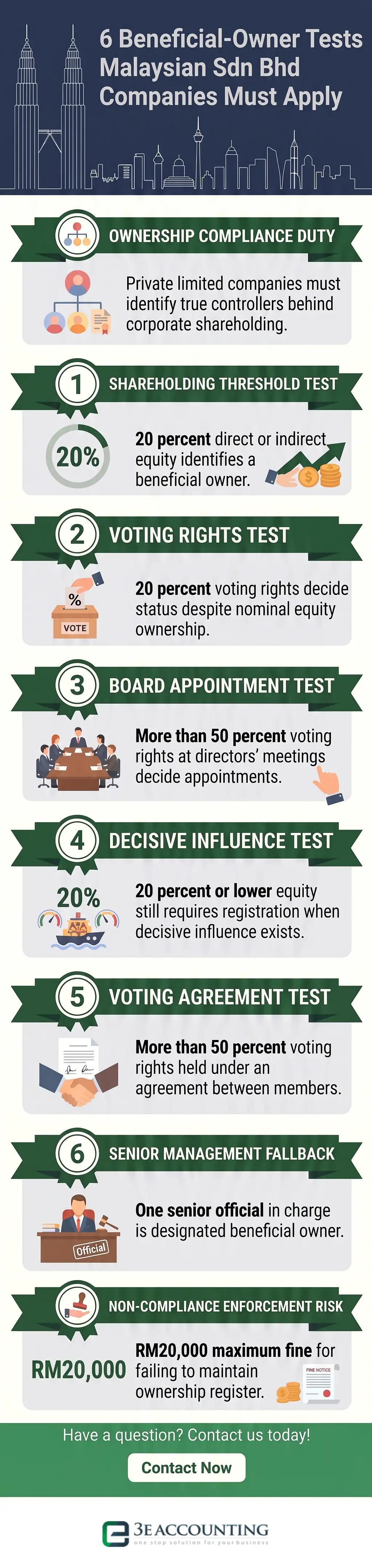
A 20 percent shareholding threshold identifies any natural person holding direct or indirect equity in the company. Under the SSM Guideline for the Reporting Framework for Beneficial Ownership of Legal Persons (2024 revision, effective 1 April 2024), entities must examine multi-tiered corporate layers to uncover the individual beneficial owners. Even when shares sit within holding vehicles, trusts, or nominee structures, the natural owner must be recorded. Furthermore, even a dormant company must apply this test to ensure complete statutory transparency.
How Does the Voting Rights Test Work?
A 20 percent voting rights threshold determines beneficial owner status irrespective of nominal equity ownership. Private entities frequently issue distinct share classes where voting power differs substantially from paid-up capital. Companies must assess shareholder covenants, proxy agreements, and pooling contracts that govern general meeting decisions. Anyone exercising at least one-fifth of company voting power meets the statutory threshold.
How Does the Board Appointment Test Work?
A majority (more than 50 percent) of voting rights at directors’ meetings is the board-appointment benchmark. The test applies where an individual has the right or power, directly or indirectly, to appoint or remove director(s) holding that majority. The SSM beneficial ownership guideline evaluates direct or indirect governance power over board appointments. Any individual holding legal authority to install or dismiss a majority of directors exercises decisive operational control. Company constitutions and investor pacts must be checked to confirm who holds these appointment rights.
Significant Influence Test
Less than 20 percent equity still triggers registration when an individual exercises decisive operational influence. SSM's beneficial ownership guideline captures shadow directors and major commercial influencers who steer strategic business decisions. Effective control may stem from financing arrangements, exclusive intellectual property licences, or close family ties. If someone routinely dictates commercial policies, the company must register that individual in the beneficial owner Sdn Bhd assessment.
Beneficial ownership tests for Malaysian Sdn Bhd companies
| Test | Threshold or fallback | What to assess |
|---|---|---|
| Shareholding | 20% shareholding | Direct or indirect equity held through corporate layers, trusts or nominee structures |
| Voting rights | 20% voting power | Voting rights, shareholder covenants, proxy agreements and pooling contracts |
| Board appointment | Power to appoint or remove director(s) holding a majority of voting rights at directors’ meetings | Constitutions and agreements governing those appointment or removal rights |
| Significant influence | Decisive operational influence, including below 20% equity | Financing arrangements, intellectual property licences and close family ties |
| Member voting agreement | A member who, under an agreement with another member, controls alone a majority of voting rights | Agreements that create majority voting control |
| Senior management fallback | Natural person in senior management primarily in charge of management | Use only after all reasonable measures are taken and the company has no beneficial owner, cannot identify one, or is still obtaining the information |
How Does the Voting-Agreement Control Test Work?
More than 50 percent of the company’s voting rights is the threshold when a member, under an agreement with another member, controls alone a majority of those rights; that member meets a beneficial-owner criterion. SSM’s guidelines require companies to assess the prescribed ownership and control criteria rather than a separate commercial-gains test. Profit or dividend entitlement alone does not establish beneficial ownership; companies must apply SSM’s prescribed ownership and control criteria. Side agreements and trust structures should still be reviewed because they may reveal a voting arrangement that meets the control threshold, not because earnings extraction is itself a beneficial-owner test.
Senior Management Fallback Test
One senior management official who is primarily in charge of the company’s management must be designated as the beneficial owner on record only after all reasonable measures are taken and the company has no beneficial owner, cannot identify one, or is still obtaining beneficial-ownership information. When exhaustive enquiries fail to reveal an ultimate beneficial owner, Malaysian law mandates this statutory fallback. Entities typically record their managing director or chief executive officer in the register. Appointing reliable corporate secretarial services in Malaysia ensures all investigative steps are properly recorded.
Non-Compliance Enforcement Risks
A fine of up to RM20,000 applies to companies failing to maintain their beneficial ownership register. Under Section 60B of the Companies Act 2016 and the 2024 Beneficial Ownership Guideline revision (effective 1 April 2024), continuing offences attract daily fines of RM500. Submitting false beneficial ownership information carries additional statutory penalties reaching RM50,000 and three years of imprisonment. Maintaining verified records protects your board and executive officers from severe enforcement measures.
Ensure Beneficial Ownership Compliance Today
Our Corporate Professional Advisors help companies audit ownership chains and maintain statutory registers accurately.
Frequently Asked Questions
A beneficial owner is an individual who ultimately owns or controls at least 20 percent of company shares or voting rights, or exercises ultimate effective control over corporate governance and operations.
A company must update its internal register within 14 days of receiving confirmed information and lodge changes electronically with the Companies Commission of Malaysia (SSM) within 14 days of recording.
If exhaustive enquiries fail to reveal any individual meeting the ownership or control criteria, the company must designate at least one lead senior management official as the beneficial owner on record.
Yes, dormant companies are not exempt from statutory beneficial ownership reporting requirements and must maintain verified controller records at their registered office.
Failure to maintain or lodge beneficial ownership records attracts fines of up to RM20,000 under Section 60B, with ongoing daily fines of RM500 and higher criminal penalties for false declarations.

Abigail Yu
Director
Abigail Yu oversees executive leadership at 3E Accounting Group, leading operations, IT solutions, public relations, and digital marketing to drive business success. She holds an honors degree in Communication and New Media from the National University of Singapore and is highly skilled in crisis management, financial communication, and corporate communications.