Which Companies Qualify for Malaysia’s Preferential 15% SME Tax Rate?
Could your company lose Malaysia's preferential SME rates despite sitting below the headline income thresholds? LHDN applies statutory tests covering capital, income, shareholding structure and business activity. In this guide, we explain the eligibility checks for SME tax tiers and the separate Form C filing-compliance step. Those checks include Malaysian residence and incorporation, capital, gross business income, ownership restrictions and the exclusion for asset-backed-securities special-purpose companies.
Malaysia's qualifying small and medium enterprises pay just 15% corporate tax on their first RM150,000 of chargeable income for Year of Assessment 2026. That rate is not automatic. Fail any single eligibility check and your company falls to the flat 24% rate from the first ringgit of profit. We help clients review their structure against these criteria before every filing season.
What Is Paid-Up Capital Limit?
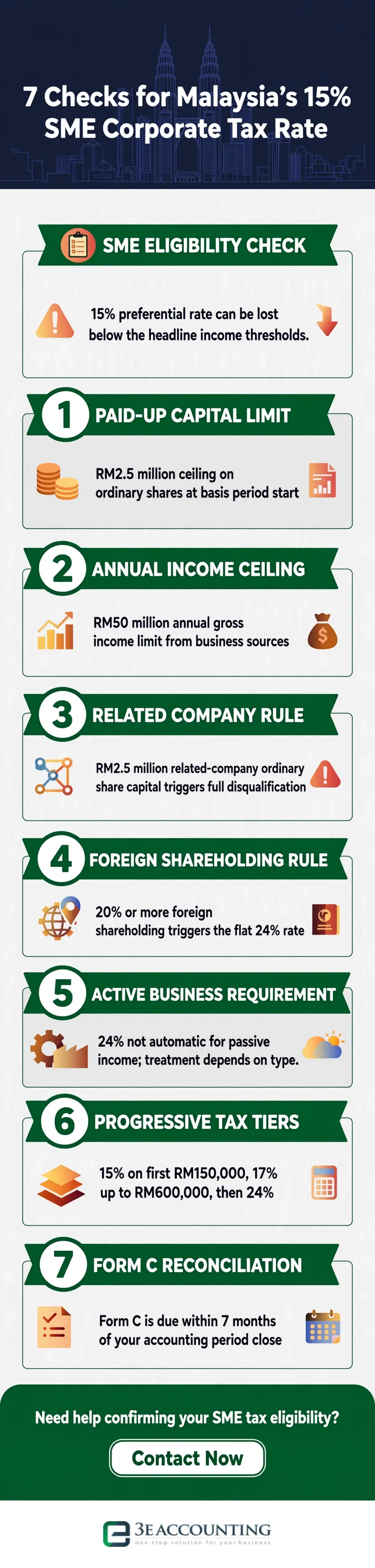
Your paid-up capital in respect of ordinary shares must not exceed RM2.5 million at the start of the basis period. When forming a company in Malaysia, most startups incorporate with as little as RM1 of capital. The limit rarely binds early on. But once shareholders inject larger funds, the concession falls away. Verify the figure against your Companies Commission of Malaysia (SSM) records before claiming the preferential rate.
What Is the Income Ceiling?
Annual gross income from business sources must not exceed RM50 million. LHDN measures gross income from all business sources for the basis period, not just profit. Most SMEs sit far below this line, but a single strong year of sales can push a trading company over it. Track gross income monthly so you spot any breach well before the year of assessment closes.
Does Related Control Disqualify?
A company is disqualified if a related company has paid-up capital in respect of ordinary shares exceeding RM2.5 million. For this test, a company is related when more than 50% of its paid-up capital in respect of ordinary shares is directly or indirectly owned or controlled by the other company. Map your register of members and the ownership chain against this more-than-50% threshold before filing. In practice, group structures are where most failed eligibility claims originate.
Screen Foreign Ownership Levels
Foreign shareholding of more than 20% removes your SME preferential rates. Since Year of Assessment 2024, LHDN treats companies with more than 20% foreign shareholding as outside the SME concession. The rule covers foreign corporate or non-citizen individual shareholding. They are taxed at the flat 24% from the first ringgit of profit. Review your share register against this threshold every year, because even small transfers can cross the line.
Malaysia SME 15% Corporate Tax Rate: LHDN Eligibility Checks at a Glance
| LHDN check | Threshold / requirement | What happens if missed |
|---|---|---|
| Paid-up capital | Not more than RM2.5 million at the start of the basis period | The SME preferential rates are denied |
| Gross business income | Not more than RM50 million from all business sources for the basis period | The SME preferential rates are lost |
| Related company | No related company in the group with paid-up capital above RM2.5 million | The 15% tier is denied |
| Foreign ownership | Foreign/non-citizen shareholding must not exceed 20% | Flat 24% applies from the first ringgit of profit |
| Active business income | Your company must have gross income from business sources, but the SME-rate rules do not require active trading to be its main income. | Tax treatment depends on the income type and the company's classification and facts |
| Progressive tiers | 15% on first RM150,000; 17% up to RM600,000; 24% above | Higher chargeable income is taxed at the higher tiers |
| Form C reconciliation | e-C return due within 7 months of accounting period close; e-Filing grace also applies to balance-of-tax payment | Declaration must reconcile with financial statements and statutory records |
Confirm Active Business Operations
Passive investment income is not automatically taxed at 24%; its treatment depends on the income type, while a company with no gross income from business sources cannot qualify for the SME rates. The key qualification point is having gross income from business sources, not an "active trading" label. That can include manufacturing, professional services or starting a coffee shop business in Malaysia.
The investment-holding analysis is not a simple label. The 24% treatment depends on the company's classification and facts. Rental income may be business income depending on the facts. Dividend treatment is not a flat 24% rule in every case. Do not assume a company fails this check merely because it earns dividends, rentals or interest. Before claiming SME status, confirm your company has gross income from business sources and apply the correct tax treatment to any dividend, rental or interest income based on the facts.
Apply Progressive Income Tiers
The 15% rate applies only to your first RM150,000 of chargeable income. Qualifying SMEs pay 17% on the next RM450,000, up to RM600,000, and 24% above that. Budget your tax provision on all three tiers, not the headline rate alone. Build your estimate of tax payable in Malaysia across the full schedule to avoid an unexpected year-end liability.
Validate Form C Declarations
Form C must reach LHDN within 7 months of your accounting period close. Form C reconciliation is a filing-compliance requirement. It documents the chargeable income reported in your financial statements and statutory records rather than determining eligibility for the SME tax tiers. LHDN's 2026 filing programme confirms the e-C deadline. The one-month e-Filing grace period applies to both Form e-C filing and payment of any balance of tax when the return is filed through e-Filing. A rigorous unaudited financial statement compilation keeps your declaration defensible if the return is reviewed.
Is Your Company Eligible for the 15% Rate?
Our team reviews your shareholding, capital and income against every LHDN test before you file.
Frequently Asked Questions
Qualifying SMEs pay 15% on the first RM150,000 of chargeable income, 17% on the next RM450,000, and 24% on the remainder, consistent with the LHDN schedule in force since Year of Assessment 2024.
Paid-up capital in respect of ordinary shares must not exceed RM2.5 million at the beginning of the basis period for a company to qualify as an SME.
Yes. Since Year of Assessment 2024, companies with more than 20% foreign shareholding do not qualify for the preferential rates and pay the flat 24% corporate tax rate.
Gross income from all business sources must not exceed RM50 million for the relevant year of assessment, measured on total gross income rather than profit.
Under LHDN's 2026 filing programme, the e-C return is due within 7 months of the close of the accounting period that forms the basis period. The one-month e-Filing grace period extends both filing and payment of any balance of tax when Form e-C is submitted through e-Filing.

Abigail Yu
Director
Abigail Yu oversees executive leadership at 3E Accounting Group, leading operations, IT solutions, public relations, and digital marketing to drive business success. She holds an honors degree in Communication and New Media from the National University of Singapore and is highly skilled in crisis management, financial communication, and corporate communications.