

Fourteen calendar days — that is the standard window HASiL gives a taxpayer or employer to respond to an income-tax or employer audit document request. For a company whose records sit across an ERP, a bank portal, MyInvois and an overseas parent's server, that fortnight disappears quickly.
In this guide, we explain what an LHDN tax audit notice in Malaysia typically requires. We also explain who should own the response. Finally, we show how to avoid inconsistencies in the general ledger, tax computations and MyInvois data.
What Does an LHDN Tax Audit Notice Require in Malaysia?
For ordinary income-tax and employer audits, the standard rule is a response within 14 calendar days from the date of the request letter.
According to the Inland Revenue Board of Malaysia (LHDN), also known as HASiL, the standard response window is short. HASiL's Income Tax and Employer Tax Audit Framework sets the same deadline for general and comprehensive reviews. The taxpayer or employer must respond within 14 calendar days from the date of the document-and-information request letter.
That 14-day period is the standard stated in the framework as at 17 September 2026. It is not a substitute for reading your own letter. The scope, date, stated deadline and submission instructions in the actual notice govern, so verify them first.
The framework also distinguishes review types. A general review is document-based and may be handled through correspondence. A comprehensive review can involve interviews, review of wider business records and a visit — at the taxpayer's premises, HASiL's office, online, or another agreed location. Not every document request is a field audit, so classify the matter from the letter before allocating resources.
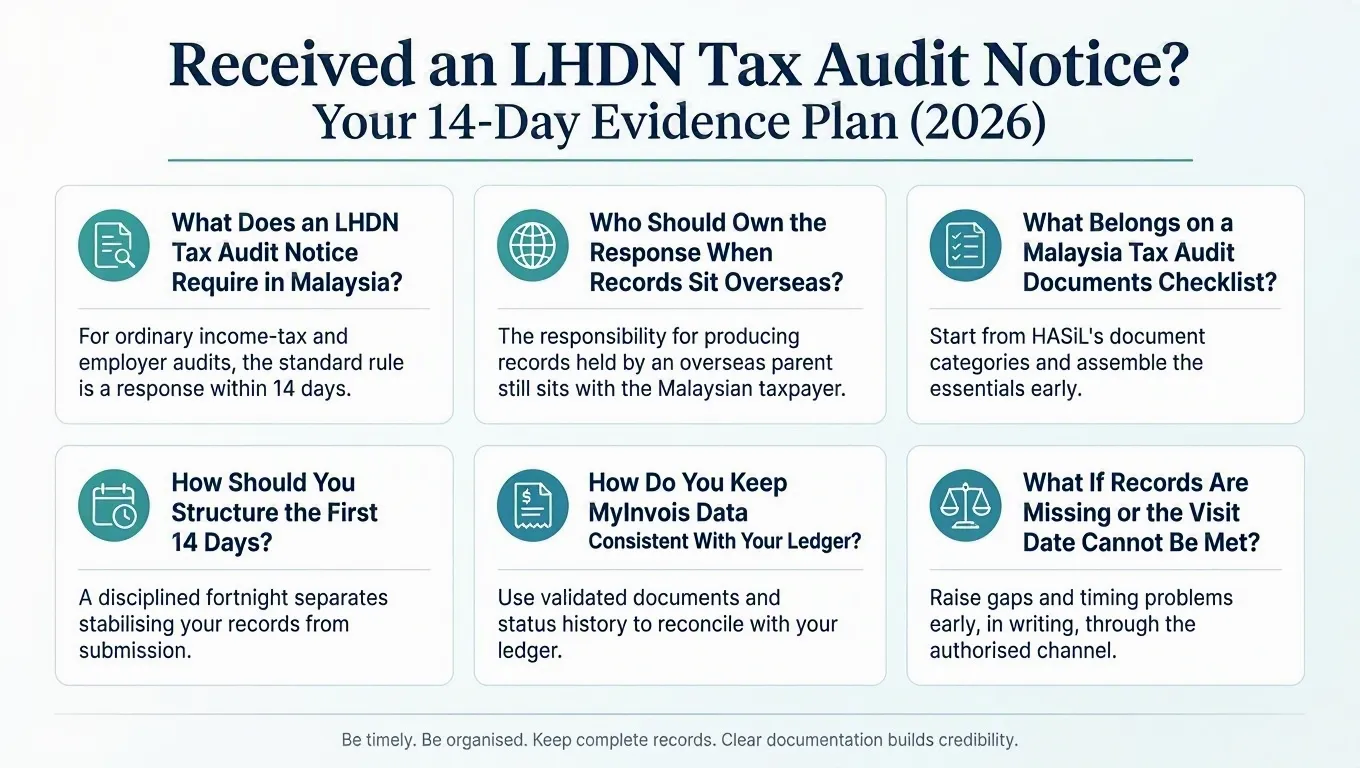
Who Should Own the Response When Records Sit Overseas?
The responsibility for producing records held by an overseas parent stays with the Malaysian taxpayer.
HASiL's audit framework expressly places responsibility on the taxpayer or employer to obtain related-company documents held outside Malaysia and submit or make them available for audit. An overseas parent does not take on a direct Malaysian filing obligation merely because it holds the records. The duty belongs to the local company.
In practice, that means overseas-parent items need the earliest escalation. Send the group finance controller an itemised request covering format, period and an internal due date. Move unresolved items up the regional finance and legal chain within days, not weeks, and keep local directors informed throughout.
Representation has its own rules. HASiL's tax-agent guidance states that only tax agents with valid Ministry of Finance approval may negotiate tax matters with HASiL officers on a client's behalf. The appointment must be made formally through a tax-agent appointment letter, a copy of which must be submitted to HASiL before the agent acts; the agent must produce valid approval proof if requested. Separately, HASiL's MITRS guidance says a licensed tax agent may be appointed to submit specified documents, while responsibility for submission remains with the chargeable person. Note that this is MITRS guidance for documents specified under section 82B — it is not a complete rulebook for every audit-response channel.
HASiL Audit Types and Review Methods
| Review type | What it involves | Typical evidence focus |
|---|---|---|
| General review | Document-based review, often handled through correspondence | Core records for the years and taxes stated in the letter |
| Comprehensive review | Interviews, wider business records, and a visit at the premises, HASiL's office, online or an agreed location | Full ledger, source documents and factual explanations |
| Transfer-pricing audit | Review of agreements, contracts and other documents on related-party and third-party activities, plus transfer-pricing documentation | Intercompany charges, allocation schedules, withholding-tax support |
| e-Invoice compliance review | Officers may access computer systems, servers or devices and download electronic accounting data | MyInvois documents, status logs and reconciliations to ledgers |
| Tax investigation | A separate process with its own procedures and protections | Follow the specific instructions in the notice |
What Belongs on a Malaysia Tax Audit Documents Checklist?
A workable checklist starts from HASiL's own document categories and adapts them to the scope of the actual letter.
For companies within the applicable MITRS programme, HASiL lists audited or unaudited financial statements, income-tax computations, complete capital-allowance schedules and incentive calculations where applicable as core tax-supporting documents. Do not treat that list as complete: audit requests are scope-specific. HASiL also expects companies to keep records and account books for seven years, which is why preservation matters more than reconstruction.
The map below is a non-exhaustive starting point. Adapt every category to the request letter, and assign an owner and a reviewer to each item. Our companion guide to building a reconciled Form C evidence pack covers the filing side in more detail. A Chinese-language companion on the MITRS 2026 Form C对账文件包 is also available, and Malay-speaking colleagues can use our guide to the pakej bukti Borang C MITRS 2026.
Statutory records deserve the same discipline. Registers are normally maintained under professional company secretary services in Malaysia, and board approvals should be checked against the beneficial ownership tests that current SSM reporting expects.
1. Core Tax and Statutory Filings
Signed financial statements, Form C, the tax computation, capital-allowance schedules and payment records form the backbone of the file. Reconcile profit before tax to the tax computation, Form C and the assessment or payment position before anything else is gathered.
2. Ledger and System Records
The final trial balance, full general ledger, chart of accounts and journal listing come from the ERP or accounting system. Reconcile opening balances, closing trial balance and consolidation or audit adjustments to the signed accounts.
3. Sales, Contracts and MyInvois Records
Invoices, credit notes, contracts, delivery or service evidence, and validated e-invoices with their status logs belong together. Reconcile revenue by month and by customer to the general ledger, bank receipts and contract milestones.
4. Purchases, Payroll and Bank Records
Supplier statements, goods receipts and payments should tie to expense and asset accounts. Payroll totals must reconcile to the general ledger and statutory submissions, and every bank account should be reconciled with transfers and director movements explained.
5. Fixed Assets and Disposals
The fixed-asset register should reconcile additions and disposals to the general ledger, purchase invoices, the capital-allowance schedule and sale proceeds. Disposal gains and losses deserve a second look before submission.
6. Intercompany and Statutory Records
Intercompany agreements, invoices, allocation schedules, transfer-pricing documentation and withholding-tax support should reconcile across both counterparties, including foreign-exchange differences and settlements. Board minutes and registers should match approval dates and terms to recorded transactions without retrospectively changing history.
Malaysia Tax Audit Evidence Map
| Document category | Usual owner | Typical source system | Reconciliation before filing |
|---|---|---|---|
| Financial statements, Form C, tax computation, capital allowances | Finance director and tax agent | Consolidation file, tax software, MyTax | Profit before tax to computation, Form C and payment position |
| Trial balance, general ledger, journal listing | Financial controller or accounting team | ERP or accounting system | Opening and closing balances to signed accounts |
| Sales ledger, contracts, invoices, delivery evidence | Sales operations and finance | ERP, CRM, shared drive | Revenue by month and customer to ledger and bank receipts |
| MyInvois validated documents and status logs | Finance or e-invoicing lead | MyInvois portal or API, ERP | Document counts and values to sales and purchase ledgers |
| Bank statements and payment listings | Treasury or finance director | Bank portal, loan files | Every account to the ledger, with transfers explained |
| Intercompany agreements and allocation schedules | Group finance or tax | Parent server, consolidation system, local ERP | Both counterparties, foreign-exchange differences and settlements |
How Should You Structure the First 14 Days?
A disciplined fortnight separates stabilising your records from submitting a controlled, indexed response.
The plan below is a suggested control-plan template, not a statutory timetable and not a universal procedure. The date and method stated in the actual letter govern. Confirm role titles, escalation points, sign-offs and data-room controls against your own approved procedures and engagement terms before relying on it.
Whatever template you use, the sequence matters. Stabilise first, gather second, reconcile third, and submit last — through one authorised contact only.
Step 1: Days 1–3 — Authenticate, Preserve and Map
Verify the notice through the client's MyTax correspondence or the stated HASiL officer, and record the actual receipt date and deadline. Identify the years of assessment, entities, taxes and transactions in scope, and check whether the letter has investigation or enforcement features. Instruct staff not to contact the officer independently, amend ledgers, recreate documents or delete email. Appoint one response lead, open a restricted evidence room and a request tracker, and preserve relevant ERP, email, MyInvois and bank data.
Step 2: Days 4–7 — Gather and Escalate
Map each requested item to an owner and a reviewer. Freeze a trial balance and general-ledger snapshot, then reconcile them to the signed financial statements, Form C and the tax computation. Classify missing items as retrieval, reconstruction or technical-position issues rather than quietly filling the gaps. Escalate every overseas-parent item with an itemised request covering format, period and internal due date.
Step 3: Days 8–12 — Reconcile and Review
Run transaction sampling plus bank-to-ledger, revenue-to-MyInvois and intercompany reconciliations. Draft factual explanations for every difference, and identify early whether an extension or staged submission is needed. A senior reviewer should challenge inconsistencies and remove duplicates, drafts and legally privileged material that should not be submitted casually.
Step 4: Days 13–14 — Confirm and Submit
Local management confirms completeness and factual accuracy — the exact sign-off should follow your engagement terms and governance requirements. The appointed tax agent approves the cover letter and the indexed response pack. One authorised contact submits through the channel the letter specifies, and retains proof of delivery.
Do and Don't in the First 14 Days
| Do | Don't |
|---|---|
| Verify the notice and record the receipt date and deadline | Contact the LHDN officer independently as a first reaction |
| Preserve ERP, email, MyInvois and bank data immediately | Amend ledgers or delete email after the letter arrives |
| Freeze a trial balance and general-ledger snapshot | Recreate or backdate historical documents |
| Classify missing items as retrieval, reconstruction or technical issues | Quietly fill gaps to make the file look complete |
| Route all communication through one authorised contact | Submit drafts, duplicates or privileged material casually |
| Escalate overseas-parent items in the first days | Leave parent-held records to the final week |
How Do You Keep MyInvois Data Consistent With Your Ledger?
MyInvois can supply validated documents and their status history, but the numbers still need a controlled reconciliation.
HASiL's documentation for the MyInvois Portal describes document submission, cancellation, buyer rejection, document search and retrieval of source documents with tax-authority metadata. That capability does not guarantee a one-to-one match with your general ledger. Check your implementation, period and retention or export records before assuming the datasets align.
Differences can arise from consolidated invoices, rejected or cancelled documents, credit notes, foreign transactions, timing cut-offs and transactions not represented by a normal invoice. Preserve the original status logs, classify every difference by cause, and correct operational errors prospectively or through the permitted document process — never by overwriting exported data.
Access works both ways. Under HASiL's e-Invoice compliance-review framework, officers may access relevant computer systems, servers or devices. They may download electronic accounting data. The transfer-pricing framework also contemplates access to computer facilities for electronically stored documents. Address access method, confidentiality, security and the precise scope of the letter with your appointed adviser rather than granting unrestricted access. If you are still onboarding, see our guide on choosing an e-Invoice ready agent.
1. Revenue Timing
A service milestone recognised in the December ledger may be invoiced, or validated as an e-invoice, only in January. Where this arises, the cause is usually month-end accrual accounting or delayed operational sign-off. A contract-and-milestone schedule, with a bridge between accounting recognition and invoice issuance, explains the gap better than forcing the two datasets to match.
2. MyInvois Versus Sales Ledger
Compare document counts and values, then classify each difference as timing, exemption, cancellation, rejection or a transaction outside the normal invoice process. Keep the status logs as primary evidence of what happened.
3. Consolidation and Audit Journals
Adjustment journals can appear in the signed accounts but not in the operational ledger extract first supplied. Build a controlled bridge from the frozen pre-adjustment trial balance, through each journal, to the final accounts and tax computation.
4. Unidentified Bank Receipts
Receipts posted to directors' current accounts or suspense, because remittance advice was missing, need tracing. Follow bank references, customer statements, intercompany confirmations and subsequent clearing, then present a movement schedule rather than an unsupported narrative.
5. Intercompany Charges
A management charge can agree to the parent's invoice yet disagree with the local allocation schedule or withholding-tax treatment. Reconcile the foreign-currency amount, allocation key, benefit evidence, settlement and withholding position separately. If an error requires a tax correction, quantify it and agree the disclosure or amendment approach with the appointed tax agent before anything changes.
Suggested Response Governance Model
| Party | Suggested role | Key duty |
|---|---|---|
| Malaysian management | Owns facts and completeness | Confirms the scope and the completeness of the final pack |
| Overseas group finance | Supplies parent-held evidence | Provides intercompany agreements, allocations and invoices to internal deadlines |
| Local accounting team | Produces reconciliations | Freezes the trial balance and bridges ledger, accounts and tax computations |
| Appointed tax agent | Controls communications | Acts as the single authorised contact and approves the indexed response |
What If Records Are Missing or the Visit Date Cannot Be Met?
Raise gaps and timing problems early, in writing, through the authorised contact — never by silence.
HASiL's framework allows a taxpayer or employer to contact the relevant State Operations Director or Division Director to confirm a notified audit visit. The same framework allows an application to postpone a notified visit for reasonable and unavoidable reasons.
That right relates to a notified visit. It is not a guaranteed extension of a document-request deadline, and extensions should never be assumed. If more time is genuinely needed, request it with reasons before the stated date rather than after it has passed.
Where an original record cannot be located, cautious general practice points to preparing a current-dated memorandum supported by contemporaneous records, rather than backdating or recreating historical documents. This is general guidance, not a guaranteed acceptable method to HASiL. Confirm the approach with your appointed tax agent and, where the position is sensitive, Malaysian legal advisers.
Conclusion
An LHDN tax audit notice Malaysia letter starts a short, unforgiving clock. The standard response window is 14 calendar days. The letter itself sets the scope. The local company remains responsible for overseas records. The winning posture is classification first, preservation second, reconciliation third and a single authorised submission last.
The real risk in any audit response is not the audit — it is inconsistency. A ledger, MyInvois total or bank movement that does not reconcile needs a clear explanation. Each difference should be controlled before submission. A controlled evidence room, a frozen trial balance and a request tracker prevent most of those breaks.
3E Accounting Malaysia is a Corporate Services Provider. It helps companies in Malaysia and multinational-owned companies prepare coordinated, reconciled responses to LHDN document requests. It also provides corporate secretarial, accounting, tax and business advisory services. We help clients classify the letter, map every request to an owner, and assemble evidence that holds together under review. Talk to our team before the fortnight runs out.
Need Help Preparing Your LHDN Audit Response?
Our team can help you classify the letter, build the evidence map and assemble a reconciled response pack within the response window.
Frequently Asked Questions
For ordinary income-tax and employer audits, HASiL's framework requires a response within 14 calendar days from the date of the request letter. That is the standard as at 17 September 2026 — always check the scope, date and stated deadline in your actual letter, as the letter governs.
HASiL's framework confirms you may apply to postpone a notified audit visit for reasonable and unavoidable reasons, through the relevant State Operations Director or Division Director. It does not guarantee an extension of a document-request deadline. If more time is needed, request it with reasons before the stated date.
The Malaysian taxpayer. HASiL's framework places responsibility on the taxpayer or employer to obtain related-company documents held outside Malaysia and make them available for audit. The overseas parent does not take on a direct Malaysian filing obligation merely by holding the records.
No. Transfer-pricing documentation becomes relevant where the audit concerns controlled transactions or transfer pricing. HASiL's transfer-pricing audit framework identifies agreements, contracts and transfer-pricing documentation among the records that may be reviewed in those cases.
Only tax agents with valid Ministry of Finance approval may negotiate tax matters with HASiL officers on a client's behalf, and their correspondence must identify the agent and approval details. A licensed agent may submit specified MITRS documents, but responsibility for submission remains with the taxpayer. Confirm any provider's approval status before engagement.

Abigail Yu
Director
Abigail Yu oversees executive leadership at 3E Accounting Group, leading operations, IT solutions, public relations, and digital marketing to drive business success. She holds an honors degree in Communication and New Media from the National University of Singapore and is highly skilled in crisis management, financial communication, and corporate communications.