
For Form C companies, section 82B of the Income Tax Act 1967 requires prescribed supporting documents through LHDN's MITRS system. The 30-day clock runs from the statutory due date of the return, not from the date the company actually filed.
In this guide, we explain how a Sdn Bhd builds a reconciled Form C evidence pack for MITRS 2026 Malaysia. We cover the working-paper chain from trial balance to upload, plus the documents HASiL prescribes. We also cover e-Invoice and capital-allowance checks, and an example close timetable that protects the deadline.
Why Does MITRS 2026 Malaysia Form C Reconciliation Start With the Statutory Deadline?
The 30-day window starts from the statutory due date for Form C, not from the date the company actually filed the return.
MITRS is HASiL's electronic channel for furnishing documents that support a filed return. For a company required to furnish Form C, the obligation began from YA 2025 and continues for YA 2026. Rollout dates and document categories differ across taxpayer types, so confirm the position for your entity rather than assuming one timetable applies to all taxpayers.
The deadline is the key control. Under section 82B, read with section 77A of the Income Tax Act 1967, prescribed documents must be furnished within 30 days after the statutory due date for the Return Form. The statutory deadline is not measured from the date the company actually filed Form C.
HASiL also requires the relevant Return Form to have been submitted before information or documents are provided through MITRS. For YA 2026, documents must be uploaded in PDF format and must not exceed 20 MB for the taxpayer for that YA. Check the live MITRS requirements and any written HASiL concession for the relevant filing period immediately before uploading. Do not assume that a weekend, public holiday or portal issue automatically extends the deadline.
MITRS Form C reconciliation therefore starts with the calendar. Set the company's statutory Form C deadline first, then calculate the 30-day MITRS deadline from that date.
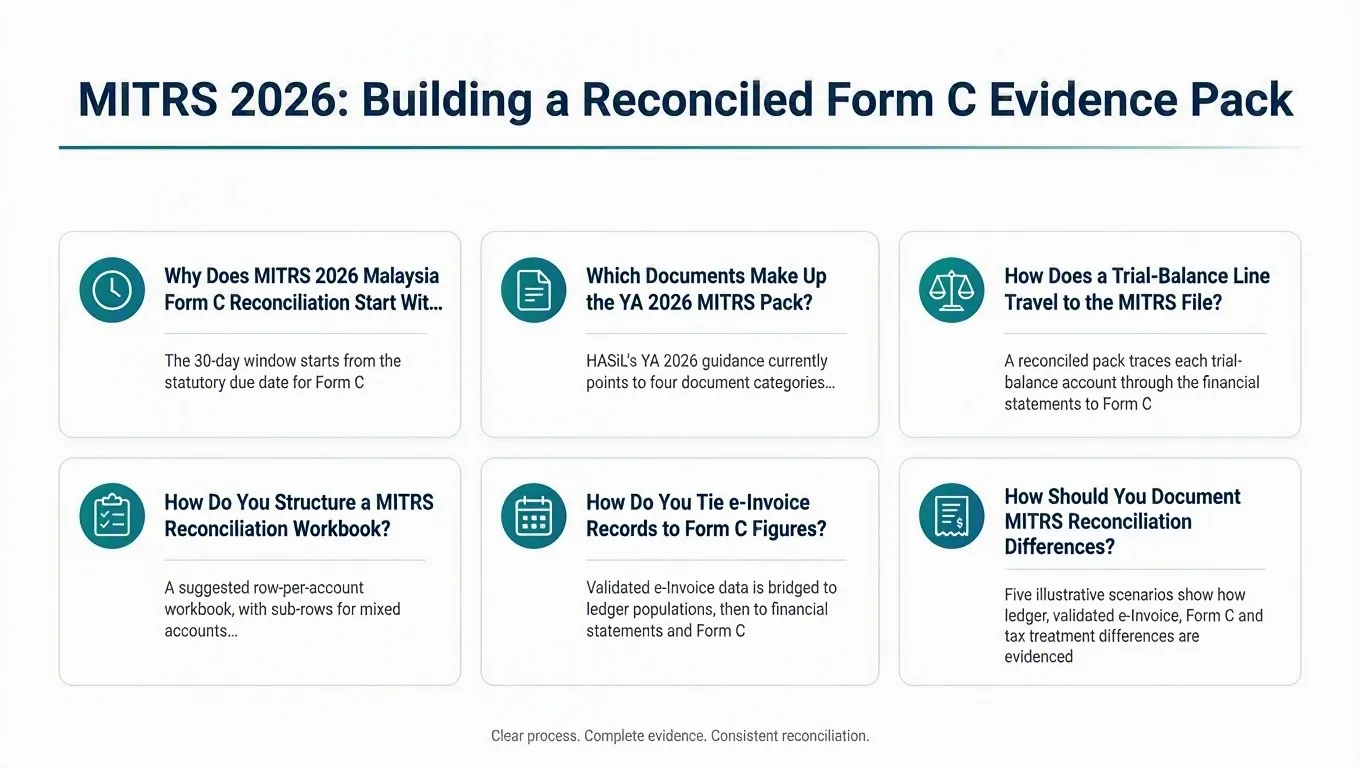
Which Documents Make Up the YA 2026 MITRS Pack?
HASiL's YA 2026 guidance currently points to four document categories for a Form C taxpayer, two of which apply only where relevant.
The prescribed categories for YA 2026 are the financial statements, the income tax computation, a complete Schedule 3 capital-allowance and charge schedule where applicable, and a complete incentive computation where applicable. HASiL's guidance gives further instructions on how each document should be prepared and detailed.
Two cautions apply. Document labels and upload requirements change between years, so confirm the current HASiL list rather than reusing last year's upload set. Some records sit naturally inside another file, and whether they must also be uploaded separately is a question only the current guidance answers.
Scope matters as well. These obligations attach to a company furnishing Form C. Even a dormant company should confirm its filing and submission position before assuming an exemption applies. The table below shows what each category must agree with.
YA 2026 MITRS Document Categories
| Document category | When it applies | What it must agree with |
|---|---|---|
| Audited or unaudited financial statements, or a liquidator’s account where applicable | Every Form C company | The applicable prescribed document and the final trial balance |
| Income tax computation | Every Form C company | Profit before tax in the financial statements |
| Schedule 3 capital-allowance and charge schedule | Where Schedule 3 capital allowances or charges are applicable | The fixed-asset register and qualifying-expenditure evidence |
| Incentive computation | Where incentives are claimed | The approval letter and its stated conditions |
How Does a Trial-Balance Line Travel to the MITRS File?
A reconciled pack traces each trial-balance account through the financial statements, the tax computation, Form C and the MITRS upload — one chain, no orphan figures.
The chain below is a suggested working method rather than the only workable design. A prudent starting point is a frozen post-audit trial balance rather than a draft management ledger, so every later figure has a single source. Each account then carries a mapping, a tax treatment and an evidence reference.
1. Freeze the final trial balance
Lock the trial balance after audit adjustments, and record each account's code, name and final amount. A locked basis prevents late journals from silently missing the tax computation.
2. Map accounts into the financial statements
Group revenue and expense accounts into a detailed profit-and-loss mapping. Those groups feed the statement of profit or loss and its notes, so every account lands in exactly one caption.
3. Build the tax-computation schedules
From profit before tax, separate schedules add back non-deductible expenses, deduct non-taxable income, allocate income by business source, and compute capital allowances, losses, incentives and tax payable. This sequence doubles as a practical Malaysia company tax computation checklist.
4. Transfer the final figures into Form C
Reconcile profit before tax, current tax expense and balance-sheet tax payable to the signed statements first. Only then transfer statutory income, aggregate income, chargeable income, tax payable and instalment fields into the return.
5. Index every MITRS file
Prepare a control index linking each prescribed document to the schedules and Form C fields it supports. The index is what turns a folder of PDFs into an evidence pack.
How Do You Structure a MITRS Reconciliation Workbook?
A suggested row-per-account workbook, with sub-rows for mixed accounts, can tie the statements, the computation and the return together.
The field groups below are a suggested template, not a fixed format. Sub-rows handle accounts carrying more than one tax treatment, such as an expense account that is only partly deductible. Control totals at the foot should prove three things. Every final-trial-balance account maps once. Financial-statement profit equals the computation's starting figure. The final computation equals the filed Form C.
A worked row illustrates the idea. Suppose a motor-vehicle depreciation charge appears in the final trial balance. It flows to administrative expenses in the statements, is added back in the tax computation, and the related claim sits in its own Schedule 3 schedule. The row records each landing point, including the Form C fields reached through adjusted income and the MITRS page reference.
Obtain the signed statements and directors' report from the provider of company secretary services in Malaysia or the client's finance team, as appropriate. Build their delivery date into the timetable rather than chasing it at the deadline.
Suggested Reconciliation Workbook Field Groups
| Field group | Example fields | What it controls |
|---|---|---|
| Identification | Entity, YA, basis period, business source | Confirms the pack belongs to the right filing |
| Trial balance | Account code and name, debit, credit, final amount | One locked source for every figure |
| Mapping | Financial-statement line, note number, detailed P&L category | Every account lands in exactly one caption |
| Tax treatment | Add-back, deduction, timing difference, capital or revenue indicator | Adjustments tie to their supporting schedules |
| Form C | Section or field, amount | The computation equals the filed return |
| MITRS | Document name, page or tab | Every figure points to its evidence |
| Control | Preparer, reviewer, status, review comment | Sign-off is visible and traceable |
How Do You Tie e-Invoice Records to Form C Figures?
Validated e-Invoice data is bridged to ledger populations, then to financial-statement revenue and expenses, and finally to the tax computation that feeds Form C.
Form C is not a per-invoice return. The invoice-level proof stays in the working papers and in any MITRS support where prescribed. What matters is the reconciliation between validated document data and the ledger populations behind the accounts.
Treat the steps below as general guidance, because the fields available depend on the client's access method and source systems. HASiL's e-Invoice implementation timeline states that taxpayers with annual revenue or sales below RM3 million are exempt from e-Invoice implementation. Businesses within scope should confirm the applicable e-Invoice requirements and document categories for their circumstances.
1. Extract the validated population
Pull validated documents by unique identifier. The MyInvois SDK documentation identifies a unique document ID and specifies original-document reference information for credit notes, debit notes and refund notes. Issue date, document type and status belong in the extract.
2. Bridge to the ledgers
Tie validated invoices, debit notes, credit notes and refund notes to the sales subledger, then to control accounts and financial-statement revenue. Reconcile purchases through the purchase ledger to expense and asset accounts.
3. Treat consolidated documents carefully
HASiL's e-Invoice Specific Guideline allows consolidated e-Invoices for eligible transactions. A one-to-one match between a consolidated document and individual point-of-sale entries may therefore be inappropriate. Consolidation is conditional and subject to exceptions.
4. Keep the proof with the pack
Where a variance is explained by cut-off, retain the timing bridge. Where a transaction sits outside the e-Invoice stream, classify it separately with its own evidence rather than forcing a false match.
How Should You Document MITRS Reconciliation Differences?
Five illustrative scenarios show how ledger, validated e-Invoice, Form C and MITRS differences can be identified and documented.
The scenarios below are illustrative patterns, not records of specific files. They show the records that may reveal a difference and the type of review that may be needed. Amounts are deliberately omitted because the appropriate accounting and tax treatment depends on the facts.
The common thread is documentation. Each pattern should be tested against the company records already held, such as the fixed-asset register, journals, source documents and validated e-Invoice data. The aim is to explain each difference with evidence rather than force an unsupported match.
Common Mismatch Scenarios and First Checks
| Scenario | What usually reveals it | Typical resolution |
|---|---|---|
| Ledger sales exceed validated e-Invoices | Issue date, validation timestamp, delivery evidence and posting date | Confirm a valid cut-off difference and carry it on a timing bridge |
| Purchases exceed the e-Invoice population | Payroll, statutory payments and overseas supplier charges without self-billed e-Invoices in the population | Issue self-billed e-Invoices for overseas suppliers; classify genuinely non-e-Invoice items separately with evidence |
| Tax computation starts from a different profit | A late audit accrual that missed the final trial balance | Correct through the audit-adjustment journal before Form C figures transfer |
| Capital-allowance claim exceeds commissioned assets | Fixed-asset register compared with the Schedule 3 schedule | Remove expenditure not yet qualifying and track it for the later period |
| Credit notes reduce revenue twice | Original invoice reference and unique e-Invoice identifier | Reverse the duplicated manual deduction |
How Are Capital-Allowance Claims Verified for MITRS?
Claims are checked against qualifying expenditure, ownership and business-use conditions — never inferred from accounting depreciation.
Schedule 3 of the Income Tax Act 1967 governs capital-allowance computations. Where a capital-allowance claim is made, HASiL's YA 2026 MITRS guidance requires a complete Schedule 3 capital-allowance and charge schedule.
As a prudent reconciliation method, review each asset against the evidence for qualifying expenditure, ownership and business use rather than inferring a claim solely from accounting depreciation. This is guidance, not a mandatory MITRS workflow. The applicable treatment of a particular asset class, rate, hire-purchase arrangement, incentive or timing condition requires review under the current law and the company's facts.
For an asset still being commissioned or supported by a deposit, entitlement depends on the governing provision, contractual facts, payment terms and the asset's actual readiness for business use. Retain the supporting evidence and obtain appropriate tax review before finalising the Schedule 3 claim. Where incentives apply, reconcile the incentive computation to the approval letter and its stated conditions.
What Rules Protect the D-Minus MITRS Close Timetable?
A D-minus timetable assigns each task an owner and a target day, leaving the deadline itself free of first-time uploads.
The timetable below is an example planning framework only, not a service standard. Role titles and target days should be confirmed against your own controlled checklist before use.
Two rules protect the close. Never schedule the first upload on the deadline day itself. Set D using the company's actual statutory MITRS deadline, then check the live portal and any written HASiL concession for the relevant filing period. Do not treat a weekend, public holiday or portal issue as an automatic extension.
If the filed Form C itself is wrong, separate the return-amendment analysis from the MITRS upload instead of disguising the error in a revised computation.
Example D-Minus MITRS Close Timetable
| Target day | Task | Suggested owner |
|---|---|---|
| D-30 | Open the job, confirm the Form C due date, obtain the filed return and acknowledgement | Tax manager |
| D-25 | Lock the final trial balance and financial-statement mapping | Finance executive |
| D-22 | Complete the detailed P&L, add-back, capital-allowance, loss and incentive schedules | Tax preparer |
| D-18 | Reconcile validated e-Invoice data to the ledgers | e-Invoice specialist |
| D-15 | Obtain signed financial statements, directors' report and asset or incentive evidence | Company secretary or client finance owner |
| D-12 | Tie profit before tax, tax payable and Form C fields to the computation | Reviewer |
| D-9 | Clear review points and check legibility, format and size limits | Tax manager |
| D-5 | Sign off the submission set | Authorised client approver |
| D-3 | Upload and independently reopen each file | Filing owner |
| D-2 | Check the portal status | Reviewer |
| D-1 | Download the acknowledgement and archive the submitted files | Filing owner |
How Long Must Form C Supporting Documents Be Kept?
LHDN requires tax records and documents used in the tax computation to be retained for seven years.
The seven-year requirement applies to the records behind the computation and the return. Longer retention may be prudent or required in particular circumstances, such as ongoing reviews or disputes, so confirm the current statutory position for your situation.
Optional document-control practices strengthen the pack. Keeping final files, submission acknowledgements, timestamps, approvals and file metadata in a read-only folder makes later verification straightforward. Some teams also record hash values so a file's integrity can be demonstrated years later. These are optional practices, not prescribed requirements, but they turn a submission into defensible evidence.
For companies in Malaysia, this discipline sits alongside the wider set of Form C supporting documents in Malaysia. The computation, the statements, the schedules and the e-Invoice reconciliations all belong in one controlled archive.
Conclusion
Building a reconciled MITRS pack comes down to one chain and one deadline. Freeze the final trial balance, then map it to the financial statements. Build the tax computation, transfer the figures into Form C, and index every prescribed document before the 30-day window closes. The checks that matter most — e-Invoice bridges, capital-allowance conditions and cut-off differences — surface early when the working papers are designed for reconciliation.
3E Accounting Malaysia helps Sdn Bhd companies prepare and review their MITRS evidence packs, from tax computations and Schedule 3 schedules to e-Invoice reconciliations. As a Corporate Services Provider, we combine corporate secretarial, accounting and tax support so every figure in your Form C traces cleanly to its source.
If the 30-day deadline is approaching and your documents do not yet reconcile, speak to our team early. The earlier the review starts, the more options remain.
Get Your MITRS Evidence Pack Right the First Time
Our tax and corporate secretarial teams can build, reconcile and submit your YA 2026 MITRS document pack before the 30-day window closes.
Frequently Asked Questions
It starts 30 days after the statutory due date for Form C under section 77A of the Income Tax Act 1967, not 30 days after the date the company actually filed. Check any written HASiL concession for the relevant filing period.
No. HASiL's guidance requires the Return Form for the relevant year of assessment to be furnished before any information or documents are provided through MITRS.
For YA 2026, documents must be PDF files and must not exceed 20 MB for the taxpayer for that year of assessment. Confirm the live portal requirements immediately before filing, as technical rules change between years.
Not necessarily. Consolidated e-Invoices may aggregate eligible transactions, so a one-to-one match with individual point-of-sale entries may be inappropriate. Consolidation is conditional and subject to exceptions under HASiL's e-Invoice Specific Guideline.
LHDN requires records and documents used in the tax computation to be kept for seven years. Longer retention may be prudent where reviews or disputes are ongoing.

Abigail Yu
Director
Abigail Yu oversees executive leadership at 3E Accounting Group, leading operations, IT solutions, public relations, and digital marketing to drive business success. She holds an honors degree in Communication and New Media from the National University of Singapore and is highly skilled in crisis management, financial communication, and corporate communications.