
IRBM permits consolidated e-Invoices only in applicable circumstances, and where permitted they must reach the MyInvois system within seven calendar days after month-end. A Malaysia subsidiary close that misses that window will feel the pressure every month.
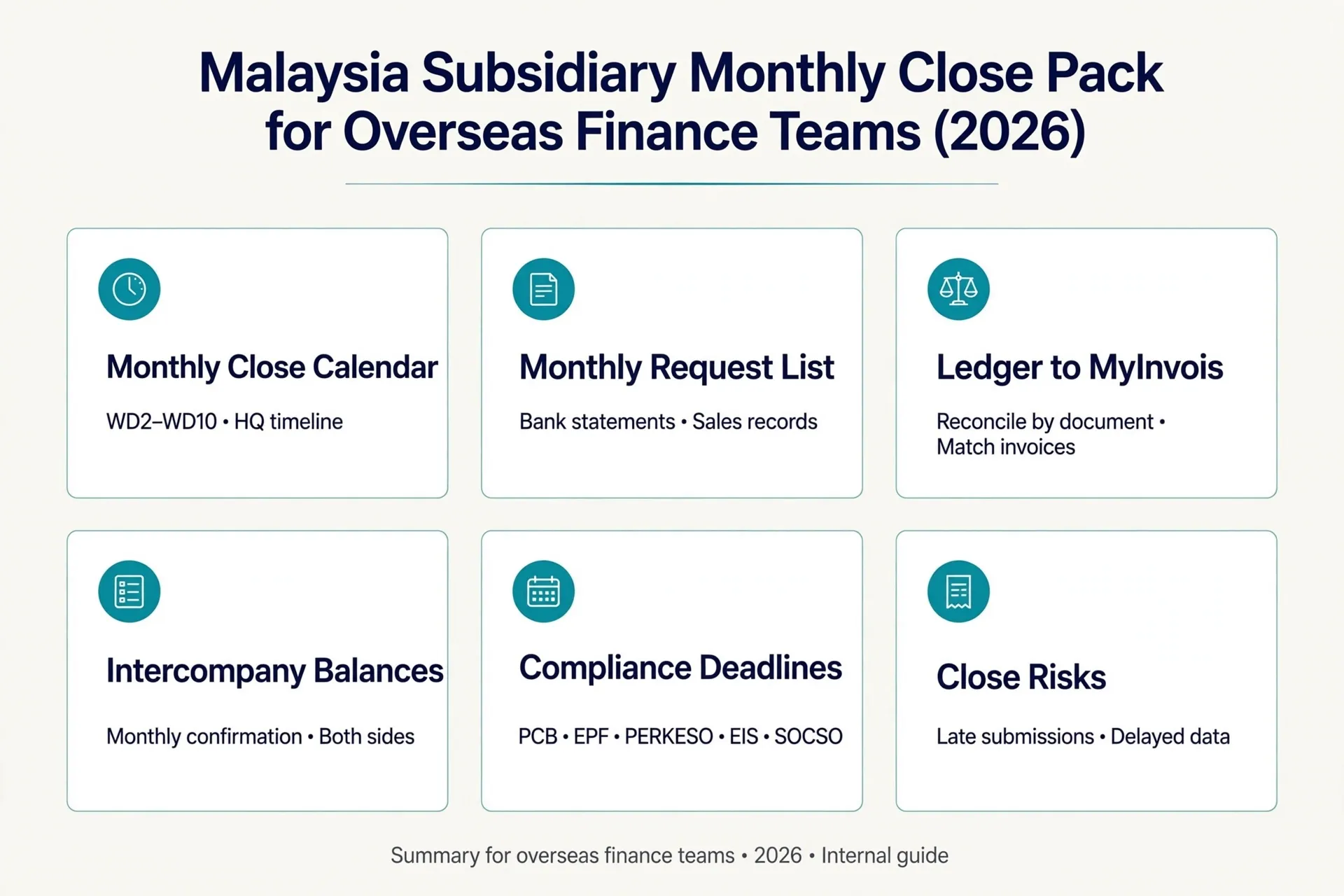
In this guide, we discuss a practical Malaysia subsidiary monthly close checklist. It covers the working-day close calendar and the records HQ should send. It also covers ledger-to-MyInvois reconciliation, intercompany confirmations, and the compliance deadlines each monthly pack must feed.
What Does a Monthly Close Calendar for a Malaysia Subsidiary Look Like?
A workable pattern runs from working day 2 to working day 10: HQ supplies records first, the provider prepares and reviews, local management resolves operational items, and HQ signs off.
Every group closes differently, but a disciplined timetable is what keeps a Malaysia subsidiary audit-ready. The calendar below is an illustrative close-calendar framework only, not a representative engagement, an actual client timetable or an approved responsibility matrix, so confirm roles, timings and service boundaries before adopting it.
In broad terms, HQ finance uploads source records first. The Corporate Services Provider then imports or posts transactions, reconciles bank and payroll accounts, and matches sales and purchase records to MyInvois. Local management answers operational questions and confirms goods or services received.
Towards the end of the cycle, the provider posts recurring journals, accruals, prepayments, depreciation, foreign-exchange revaluation and tax control-account entries. A reviewer then examines the trial balance, balance-sheet reconciliations and unusual movements before HQ reviews the draft reports and an authorised HQ approver signs off the pack.
One control deserves separate attention. Approval of the accounts is not the same as authority to file or to pay. Approval, filing access, payment authority and evidence of approval should each be documented separately in a responsibility matrix. Treat this as a recommended governance control rather than a legal rule.
Illustrative Monthly Close Calendar
| Working day | Activity | Owner |
|---|---|---|
| Day 1–2 | Upload bank statements, sales and purchase data, payroll reports, expense evidence and intercompany schedule | HQ finance |
| Day 2–4 | Import and post transactions, reconcile bank and payroll accounts, match sales and purchases to MyInvois | Corporate Services Provider |
| Day 4–5 | Resolve operational questions and confirm goods or services received | Local management |
| Day 5 | Post recurring entries, accruals, prepayments, depreciation and foreign-exchange revaluation | Corporate Services Provider |
| Day 6–7 | Review trial balance, balance-sheet reconciliations, e-Invoice exceptions and intercompany differences | Corporate Services Provider |
| Day 8 | Review draft profit and loss, balance sheet, cash flow and group-reporting bridge; approve local accruals | HQ finance and local management |
| Day 9 | Post corrections | Corporate Services Provider |
| Day 10 | Sign off the close pack | Authorised HQ approver |
What Should the Overseas Finance Team Send Each Month?
A monthly request list should cover complete bank statements, sales records, purchase and expense evidence, final payroll information, intercompany schedules, fixed-asset movements, relevant contracts, SST data where applicable, and MyInvois data.
The checklist below is a suggested request list, not a set of required formats or engagement terms. Adapt it to the subsidiary's registrations and the agreed scope of services.
Formats matter less than completeness. A complete PDF bank statement covering every day of the month, for example, can substitute for a structured export when a close is under pressure.
1. Bank and Payment Records
The preferred format is the original PDF statement plus a CSV or MT940 export from each bank and payment platform. The minimum version is a complete PDF covering every day of the month, with no gaps.
2. Sales Records
Send an invoice-level CSV or ERP export showing document number, customer, dates, currency, tax treatment and the MyInvois UUID or validation status. The minimum is a locked invoice register with all supporting invoices attached.
3. Purchases and Expenses
An accounts-payable export with the original supplier invoice or receipt for each item works best. A spreadsheet plus readable evidence for every material item is the workable minimum. Missing receipts should be parked as unsupported or employee-recoverable, never silently treated as deductible business expenses.
4. Payroll Information
Provide the approved gross-to-net register, joiner and leaver movements, variable-pay file, statutory contribution reports and payment evidence. The minimum is the final payroll register plus a headcount movement confirmation.
5. Intercompany Schedules
A transaction-level schedule by counterparty, currency and document, with the HQ ledger balance and copies of new agreements or debit notes, is preferred. A signed balance confirmation is the minimum needed for a final close.
6. Fixed Assets, Contracts and Tax Data
Include fixed-asset additions and disposals, loan movements, contracts affecting accruals, SST data where the entity is registered, and MyInvois validated-document and exception exports.
Monthly Document Request List
| Record | Preferred format | Minimum to close |
|---|---|---|
| Bank statements | Original PDF plus CSV or MT940 export | Complete PDF covering every day of the month |
| Sales records | Invoice-level CSV or ERP export with MyInvois UUID and status | Locked invoice register with supporting invoices |
| Purchases and expenses | AP export with original supplier invoices | Spreadsheet plus readable evidence for material items |
| Payroll | Approved gross-to-net register with statutory reports | Final payroll register plus headcount confirmation |
| Intercompany | Transaction-level schedule with HQ ledger balance | Signed balance confirmation |
| Other items | Fixed-asset movements, contracts, SST data, MyInvois exception exports | Items relevant to the entity's registrations |
How Is the Ledger Reconciled to MyInvois Each Month?
Reconcile by document, not by monthly totals: match every invoice, adjustment, cancellation and rejection to the ledger, and prove validated totals back to the sales control account.
This design is a recommended reconciliation approach, not a confirmed system workflow. It aligns with how IRBM e-Invoice submissions are structured, since each submission carries document identifiers and validation-related data fields.
Where IRBM rules permit consolidated e-Invoicing, the consolidated e-Invoice must be issued within seven calendar days after month-end. Consolidation is only available for sales the applicable rules allow, so never assume all sales can be consolidated.
A separate point on timing: a supplier may cancel a validated e-Invoice, and a buyer may raise a rejection request, within 72 hours of validation. After that window, the commercial correction is generally made through a new credit note, debit note or refund note e-Invoice rather than a deletion. Check the current guideline version before acting, as terminology and process details are updated periodically.
1. Data to Match
From the ledger, export invoice or adjustment number, issue date, counterparty, currency, net amount, tax and gross amount. From the MyInvois portal, pull submitted documents, validated documents with UUID and validation timestamp, invalid documents, cancellations, buyer rejection requests and their outcomes, and credit, debit or refund notes. Match on number, type, date, counterparty identifier, amount and status.
2. Typical Exceptions and Who Fixes Them
Common exceptions include:
- An accounting invoice never transmitted
- An integration item queued without a validated UUID
- An invalid submission caused by master-data errors
- A duplicate
- An invoice posted in the wrong ledger period
- A buyer rejection
- A cancelled document still sitting in revenue
The Corporate Services Provider fixes mapping and posting errors. Local management confirms the commercial facts. HQ corrects customer master data. The supplier corrects its own purchase e-Invoice.
3. The Exception Log
Every unresolved item should remain on an owned exception log recording cause, value, due date and retained resolution evidence. Present this as a recommended control rather than a mandatory process, and confirm the exception-management approach with the responsible finance lead.
Why Do Intercompany Balances Differ, and How Are They Confirmed?
A monthly intercompany confirmation should record both entities' reported balances, the difference, the reconciling item, the responsible owner and the target resolution date.
The structure below is an illustrative template, not a required format; not every field is legally necessary, and groups should adapt it to their reporting needs.
A practical Malaysia intercompany reconciliation process fields the following information:
- Entity and counterparty legal names, registration and tax identifiers, and relationship
- Agreement reference, balance date and ledger account
- Transaction document number, date, description, currency and original-currency amount
- Local-currency amount, exchange rate and debit or credit sign
- Settlement due date, withholding-tax or SST treatment where relevant, and payment reference
- Both entities' reported closing balances, the difference, reconciling item and proposed correction
- Responsible owner and target resolution date
- Confirmation by both finance contacts
As an illustrative approach, a group may exchange the confirmation monthly with its HQ intercompany contact. It may seek formal confirmation from an authorised HQ approver at quarter-end and year-end.
One common cause of differences is timing. One entity records a management fee or foreign-exchange amount in a different month from its counterparty. Neither side may notice until the confirmation arrives.
Age the balances from contractual due date, using a pattern such as current, 1 to 30, 31 to 60, 61 to 90, 91 to 180 and over 180 days. Investigate and escalate differences according to a documented group materiality policy rather than ad-hoc judgement. We recommend each group sets its own investigation and escalation thresholds, including rules for disputed, tax-sensitive or long-aged items that may need transfer-pricing review.
Which Malaysia Finance Compliance Deadlines Does the Close Feed?
The monthly pack feeds PCB, EPF, PERKESO and EIS remittances, SST-02 where registered, CP204 instalments, continuous e-Invoice compliance, and the annual Form C and SSM filings.
Each deadline below applies only where the entity has the relevant registration, employees or liability. Verify the entity's tax profile and holiday treatment before relying on any date.
HASiL's company tax guidance sets out the instalment and return timetable for companies. CP204 estimated-tax instalments are payable by the 15th of each instalment month, and the company income tax return is due within seven months after the accounting period closes. The CP204 filing and instalment position differs for new operations and other circumstances, so each entity's annual estimate of tax payable in Malaysia should be confirmed on its own facts.
The close also feeds the annual compilation of unaudited financial statements where the subsidiary qualifies for audit exemption. For a private company, financial statements and reports are circulated within six months after financial year-end. They are lodged with the Companies Commission of Malaysia (SSM) within 30 days after circulation, subject to applicable statutory requirements and any extension. Audit-exemption eligibility must be assessed separately.
Monthly Compliance Deadlines for a Malaysia Subsidiary
| Obligation | Deadline | Close-pack support |
|---|---|---|
| Monthly Tax Deduction (PCB/MTD) | By the 15th of the following month | Approved payroll register and payroll-to-ledger reconciliation |
| EPF contributions | By the 15th of the following wage month | Statutory contribution reports and payment evidence |
| PERKESO (SOCSO) and EIS | By the 15th of the succeeding month | Contribution schedules and headcount movements |
| SST-02 and payment (if registered) | Generally the last day of the month following the taxable period | Tax-code reconciliation, taxable supplies schedule and SST control account |
| CP204 instalment | By the 15th of each instalment month | Cash forecast and tax-provision bridge |
| Form e-C | Within 7 months after the accounting period closes | Finalised close packs and annual accounts |
| Consolidated e-Invoice (where permitted) | Within 7 calendar days after month-end | Validated-document register and exception log |
| SSM annual financial statements | Circulate within 6 months of financial year-end; lodge within 30 days after circulation | Signed annual financial statements and reports |
What Close Risks Recur in Malaysia Subsidiary Accounting for Overseas Companies?
The recurring risks are qualitative rather than measurable: late HQ purchase documents, intercompany differences, unsupported expenses, payroll gaps, unidentified bank items and sales-to-MyInvois exceptions.
Based on the team's professional experience, these are potential close risks rather than measured findings. They can recur in subsidiary accounting for overseas companies. The root cause is often ownership rather than bookkeeping skill.
HQ assumes the local team sent the document. The local team assumes the ERP feed is complete. Nobody owns rejected or self-billed e-Invoices. Card statements arrive, but receipts and business purpose do not. An intercompany charge lands in one ledger in a different month from the other.
A monthly close checklist for a Malaysia subsidiary only works if each of these categories has a named owner and a deadline. The table below pairs each risk with a practical control.
Recurring Close Risks and Controls
| Risk | Typical cause | Practical control |
|---|---|---|
| Late or missing HQ purchase documents | No single owner for source records | Named owner and cut-off date on the request list |
| Intercompany differences | Charges recorded in different months | Monthly confirmation with ageing and escalation rules |
| Unsupported expenses | Receipts and business purpose not captured | Unsupported or employee-recoverable classification |
| Payroll gaps | Joiner and leaver data arrives late | Headcount movement confirmation before final close |
| Unidentified bank items | No owner assigned to unusual transactions | Bank review checklist with follow-up owners |
| Sales-to-MyInvois exceptions | Integration errors or untransmitted invoices | Document-level reconciliation and owned exception log |
How Can Controls and Automation Lighten the Monthly Close?
A controlled workspace, a fixed folder structure, access controls, audit trails, automated bank and payroll imports, MyInvois status retrieval and deadline reminders can all reduce manual close work.
Treat these as optional design recommendations rather than a confirmed system specification. A controlled workspace with a fixed folder structure removes the monthly hunt for files. Access controls and audit trails make the close reviewable after the fact.
Automated bank and payroll imports shorten data entry, and document capture at the point of spend reduces missing receipts. Automated MyInvois status retrieval keeps the e-Invoice reconciliation current, and deadline reminders protect the 15th-of-month remittances.
The scope of the pack itself also changes with the entity. SST registration, employee payroll, e-Invoice scope or transition status, and whether a provider delivers full accounting rather than narrower secretarial or tax services all shape what the pack contains. Confirm service boundaries in the engagement letter before assigning any activity.
The team's professional judgement is that persistent lateness often starts with upstream record flow rather than the close itself. Scope the workflow first, then contact us to discuss how the pieces fit together.
Conclusion
A reliable close is built on three things: a clear timetable, a complete document request list and document-level reconciliation for e-Invoices and intercompany balances. Deadlines still need active review and clear ownership. Each remittance and filing should draw on a close pack that has already been reviewed.
We help clients put this Malaysia subsidiary monthly close checklist into practice. Support can cover incorporation, monthly accounting, payroll, SST and corporate income tax compliance within the agreed scope.
If your group is setting up or reviewing a Malaysia subsidiary, 3E Accounting Malaysia can scope the close pack around your entity's registrations and reporting calendar. Speak with our team to agree the timetable, roles and service boundaries before your next month-end.
Get Your Malaysia Subsidiary Close-Ready
Our team can design a monthly close pack, reconciliation workflow and compliance calendar tailored to your Malaysia subsidiary.
Frequently Asked Questions
A working-day 2 to 10 pattern can be used as an illustrative framework when HQ sends records early. It is not a confirmed timetable or responsibility matrix. The actual duration depends on record completeness, account volume and intercompany activity.
Yes, but missing receipts should be classified as unsupported or employee-recoverable rather than silently treated as deductible business expenses. Completeness of bank records, sales, final payroll and material intercompany resolution are the recommended minimums for a final close.
Under current IRBM rules, a supplier may cancel a validated e-Invoice and a buyer may raise a rejection request within 72 hours of validation. After that window, corrections are generally made through a credit note, debit note or refund note e-Invoice.
PCB is due by the 15th of the following month, EPF contributions by the 15th of the following wage month, and PERKESO and EIS contributions by the 15th of the succeeding month. Confirm the entity's own registrations and holiday treatment before remitting.
CP204 instalments are payable by the 15th of each instalment month, Form e-C is due within 7 months after the accounting period closes, and financial statements are circulated within six months of financial year-end and lodged with SSM within 30 days after circulation.

Abigail Yu
Director
Abigail Yu oversees executive leadership at 3E Accounting Group, leading operations, IT solutions, public relations, and digital marketing to drive business success. She holds an honors degree in Communication and New Media from the National University of Singapore and is highly skilled in crisis management, financial communication, and corporate communications.