

Which Malaysia Market Entry Structures Fit Foreign Investors in 2026?
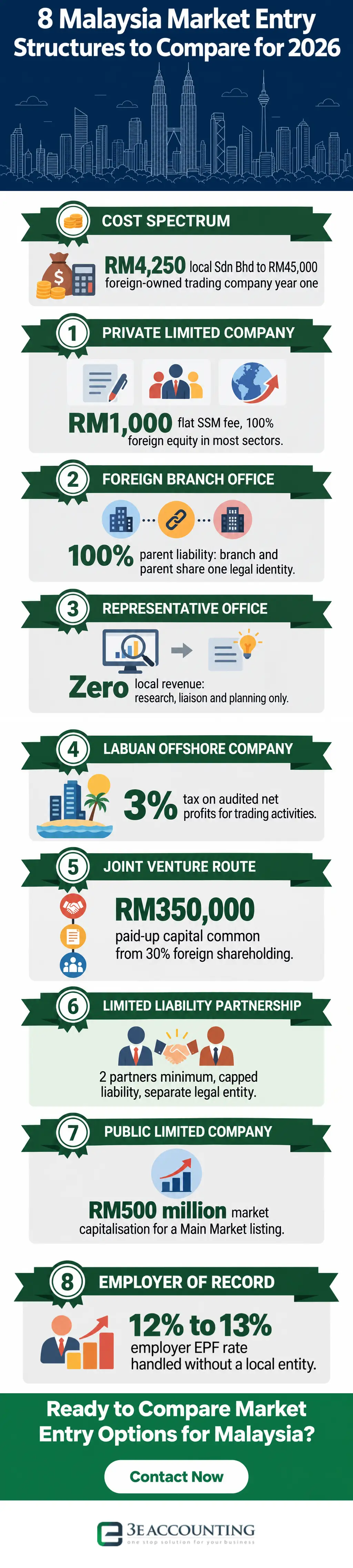
Year-one setup costs in Malaysia range from roughly RM4,250 for a local Sdn Bhd to RM45,000 for a foreign-owned trading company. Structure choice drives that spread as much as business scale does. Pick the wrong vehicle and you face:
- The RM1,000,000 WRT capital test.
- The 24% corporate rate charged from the first ringgit where preferential-rate conditions are not met.
- A structure that cannot legally trade.
Malaysia offers at least eight distinct entry models, each balancing ownership, liability, tax and speed differently. In this infographic, we compare Malaysia market entry structures for 2026. We cover private limited companies, branch offices, Labuan entities and Employer of Record hiring. You can then match the vehicle to your strategy before committing capital.
Why Choose a Private Limited Company (Sdn Bhd)?
The Companies Commission of Malaysia (SSM) charges a flat RM1,000 incorporation fee. Most sectors permit 100% foreign equity, and paid-up capital starts from RM1, with the Sdn Bhd ready in 5 to 7 days. A company secretary must be appointed within 30 days. Limited liability protection and a separate legal identity make this the default foreign company setup structure. Many groups maintain a dormant company while planning entry.
When Does a Foreign Branch Office Make Sense?
A branch office leaves the overseas parent 100% liable for obligations in Malaysia. A branch registers with SSM as a foreign company under the Companies Act 2016. It is not a separate legal entity, so debts and claims follow the parent home. It suits groups wanting direct operational control and identical trading scope. Foreign-majority trading branches still face the RM1,000,000 WRT licence capital test.
What Can a Representative Office (RO) Do in Malaysia?
A representative office may explore Malaysia but earn zero local revenue. Approvals for manufacturing-related offices come from the Malaysian Investment Development Authority (MIDA). The office can run feasibility studies, gather market intelligence and coordinate regional liaison work. It cannot sign local sales contracts or invoice customers. Funded by the head office, it is a low-cost way to test demand before committing to a permanent market entry structure.
Labuan Company
A Labuan international company carrying on Labuan trading activity is taxed at 3% of audited net profits, subject to the applicable substantial-activity requirements, under the Labuan Business Activity Tax Act 1990. Regulated by the Labuan Financial Services Authority, the midshore centre suits treasury, holding and international trading activity with multi-currency flexibility. Dealing with Malaysia residents is restricted, so Malaysian-facing activity must be planned separately from the group's international business.
Malaysia market entry structures compared for 2026
| Structure | Key figure | Ownership, liability and use |
|---|---|---|
| Private limited company (Sdn Bhd) | RM1,000 SSM fee; paid-up capital from RM1 | 100% foreign equity in most sectors; limited liability |
| Foreign branch office | RM1,000,000 WRT capital test for foreign-majority trading | Parent 100% liable; not a separate legal entity |
| Representative office (RO) | Zero local revenue | Research, liaison and planning only; MIDA approvals for manufacturing-related offices |
| Labuan company | 3% of audited net profits for trading activity | International trading, treasury and holding use; dealings with Malaysia residents restricted |
| Joint venture company | RM350,000 paid-up capital from 30% foreign shareholding | Local market knowledge paired with foreign capital |
| Limited liability partnership (LLP) | RM500 registration fee; 2 partners minimum | Capped liability; separate legal entity |
| Public limited company (Berhad) | RM500 million market capitalisation for Main Market listing | Public share offers; statutory audit and continuous disclosure |
| Employer of Record (EOR) | 12% to 13% employer EPF rate | Hires Malaysia-based talent with no local entity |
Joint Venture Company
Joint ventures with 30% or more foreign shareholding commonly need RM350,000 paid-up capital. Where a sector caps foreign equity or requires a licensed local partner, an incorporated joint venture satisfies the statutory threshold. The structure pairs local market knowledge with foreign capital, and governance runs on a shareholders' agreement. Careful drafting protects both sides during business licence applications and scaling.
Limited Liability Partnership (LLP)
A limited liability partnership (LLP) needs at least 2 partners to register. Governed by the Limited Liability Partnerships Act 2012, the LLP is a separate legal entity, so partners enjoy capped liability rather than unlimited exposure. The RM500 registration fee keeps formation light, and internal rights run on a partnership agreement. It suits smaller professional practices and specialist joint enterprises, though licensing-sensitive sectors may prefer a Sdn Bhd.
Public Limited Company (Berhad)
A Bursa Malaysia Main Market listing requires RM500 million market capitalisation at admission. A public limited company (Berhad) may offer shares to the public and mobilise large-scale capital for expansion. The model carries heavier obligations: statutory audit, prospectus oversight by the Securities Commission Malaysia and continuous disclosure on the exchange. It is a long-term capital-raising vehicle, rarely the first step for a new foreign entrant.
Employer of Record (EOR)
Statutory employer rates for the Employees Provident Fund (EPF) run at 12% to 13% of monthly wages. An Employer of Record legally hires Malaysia-based talent for you, handling EPF, SOCSO and EIS registrations, payroll and employment contracts without any local entity. It is one of the quickest low-commitment routes for testing market entry options in Malaysia. Once demand is proven, the team transfers into a new Sdn Bhd.
Ready to Compare Market Entry Options for Malaysia?
Share your activity, ownership and timeline, and 3E Accounting Malaysia will map the right structure for 2026.
Frequently Asked Questions
A private limited company (Sdn Bhd) permits 100% foreign equity in most sectors, with a flat RM1,000 SSM incorporation fee and paid-up capital from RM1.
Foreign-majority trading businesses generally need RM1,000,000 in paid-up capital for the WRT licence; joint ventures with at least 30% foreign shareholding commonly need RM350,000.
No. A representative office earns zero local revenue and cannot sign local sales contracts; it handles research, liaison and feasibility work, with manufacturing-related approvals from MIDA.
A Labuan trading company is taxed at 3% of net audited profits, while non-trading activity is taxed at 0%, subject to substantial-activity requirements, under the Labuan Business Activity Tax Act 1990.
No. It is a hiring-only entry option without a local entity; statutory employer EPF contributions of 12% to 13% of wages are handled for you until you incorporate.

Abigail Yu
Director
Abigail Yu oversees executive leadership at 3E Accounting Group, leading operations, IT solutions, public relations, and digital marketing to drive business success. She holds an honors degree in Communication and New Media from the National University of Singapore and is highly skilled in crisis management, financial communication, and corporate communications.