

When Does Malaysian Withholding Tax Apply?
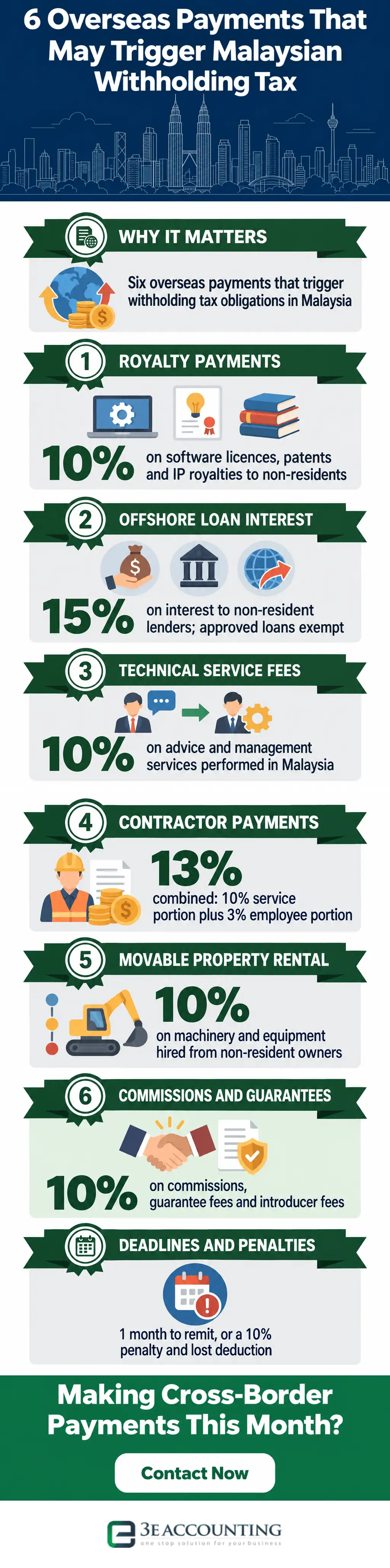
When do cross-border payments attract withholding tax in Malaysia? Under the Income Tax Act 1967, liability depends on the payment's character and source, exemptions and any applicable treaty, whether your company pays an overseas software licensor, offshore lender or foreign technical services provider. In this infographic guide, we outline six cross-border payments that commonly trigger withholding tax.
When tax is due, the payer becomes the collector. You must deduct the tax and remit it to the Inland Revenue Board of Malaysia (LHDN) within one month of paying or crediting the non-resident. The rate depends on what you pay for, and a double taxation agreement may reduce it. Missing a deduction is costly: LHDN imposes a 10% late penalty and can disallow the expense entirely. For multinational companies in Malaysia, intercompany fees make this a monthly discipline. If any sit in your payables list, our corporate services team can review them — get in touch today.
When Do Royalty and Software Licence Fees Trigger Withholding Tax?
A 10% withholding tax applies to royalties paid to non-resident licensors under Section 109. The 2026 charge covers qualifying royalties for software licences, patents, trademarks and know-how. Other software and digital advertising payments are assessed on their facts and are not necessarily royalties. Your company deducts the tax and remits it to LHDN with Form CP37. A double taxation agreement may reduce the rate with valid treaty documentation.
When Do Cross-Border Loan Interest Payments Trigger Withholding Tax?
A 15% withholding tax applies to interest paid to non-resident lenders. The 2026 rate covers offshore term loans, credit lines, and intercompany financing. Interest paid to a non-resident on an approved loan is exempt, as is interest paid to a non-resident by a bank licensed to carry on banking business in Malaysia, subject to specified exceptions. A double taxation agreement may reduce the rate, so verify the payee's treaty residence first. Loan agreements can also attract stamp duty — see our e-stamping service.
When Do Technical and Management Service Fees Trigger Withholding Tax?
A 10% withholding tax applies to technical advice, management services, and engineering support from non-residents. The 2026 charge under Section 109B applies when services are performed in Malaysia. Payments to overseas consultants, trainers, and installation advisers commonly trigger it. Deduct the tax at source and file Form CP37D.
Contract Payments to Foreign Contractors
A combined 13% withholding tax applies to payments made to non-resident contractors. Section 107A splits the 2026 charge: 10% on account of the contractor's tax liability and 3% on account of its employees' tax liabilities. The rule covers construction, installation, and service projects carried out in Malaysia. Both portions are remitted together with Form CP37A.
Cross-border payment types and potential withholding tax rates
| Payment type | Rate |
|---|---|
| Qualifying royalties, including software licences | 10% |
| Interest to non-resident lenders | 15% |
| Technical and management services performed in Malaysia | 10% |
| Payments to non-resident contractors | 13% combined |
| Movable property rentals | 10% |
| Other gains, commissions and guarantees | 10% |
Movable Property Rental and Leases
A 10% withholding tax applies when you hire movable property from an overseas vendor. The 2026 charge covers leasing or renting specialised machinery, equipment, and other movable assets from non-resident owners. These rentals fall within special classes of income under Section 109B. Deduct the tax when the rental is paid or credited to the overseas owner.
Other Gains, Commissions and Guarantees
A 10% withholding tax applies to income derived from Malaysia by non-residents that falls under paragraph 4(f). Depending on the facts, Section 109F can capture commissions, guarantee fees and introducer fees that fall under that paragraph. These payments are easily missed because they sit outside standard supplier categories. Your accounts payable review should flag them, with Form CP37F used for filing.
Remittance Deadlines and Penalty Risks
One month is all your company gets to remit withheld tax to LHDN. The clock starts on the earlier of payment or crediting. Miss the deadline in 2026 and a 10% penalty applies on the unpaid tax. Worse, LHDN can disallow the expense, adding the amount back to taxable income. Map each cross-border invoice to its withholding tax form — CP37, CP37A, CP37D or CP37F — before it falls due.
Making Cross-Border Payments This Month?
Our corporate services team reviews your overseas payment mix, applicable rates and remittance deadlines.
Frequently Asked Questions
Royalties attract a 10% withholding tax in Malaysia in 2026. Qualifying software licence and patent royalties may be subject to this rule. Other software and digital advertising payments depend on their facts and are not necessarily royalties.
A combined 13% applies under Section 107A: 10% on account of the contractor's tax liability and 3% on account of its employees' tax liabilities. Both are remitted with Form CP37A within one month of paying or crediting the contractor.
Within one month of the earlier of paying or crediting the non-resident. File the relevant form through the MyTax portal and pay via FPX (ByrHasil) or electronic telegraphic transfer.
A mandatory 10% penalty applies on the unpaid amount. LHDN may also disallow the related expense for corporate tax purposes, adding it back to your taxable income.
Yes. A treaty between Malaysia and the payee's country of residence can lower the domestic rate, provided valid documentation is obtained before the payment is made.

Abigail Yu
Director
Abigail Yu oversees executive leadership at 3E Accounting Group, leading operations, IT solutions, public relations, and digital marketing to drive business success. She holds an honors degree in Communication and New Media from the National University of Singapore and is highly skilled in crisis management, financial communication, and corporate communications.