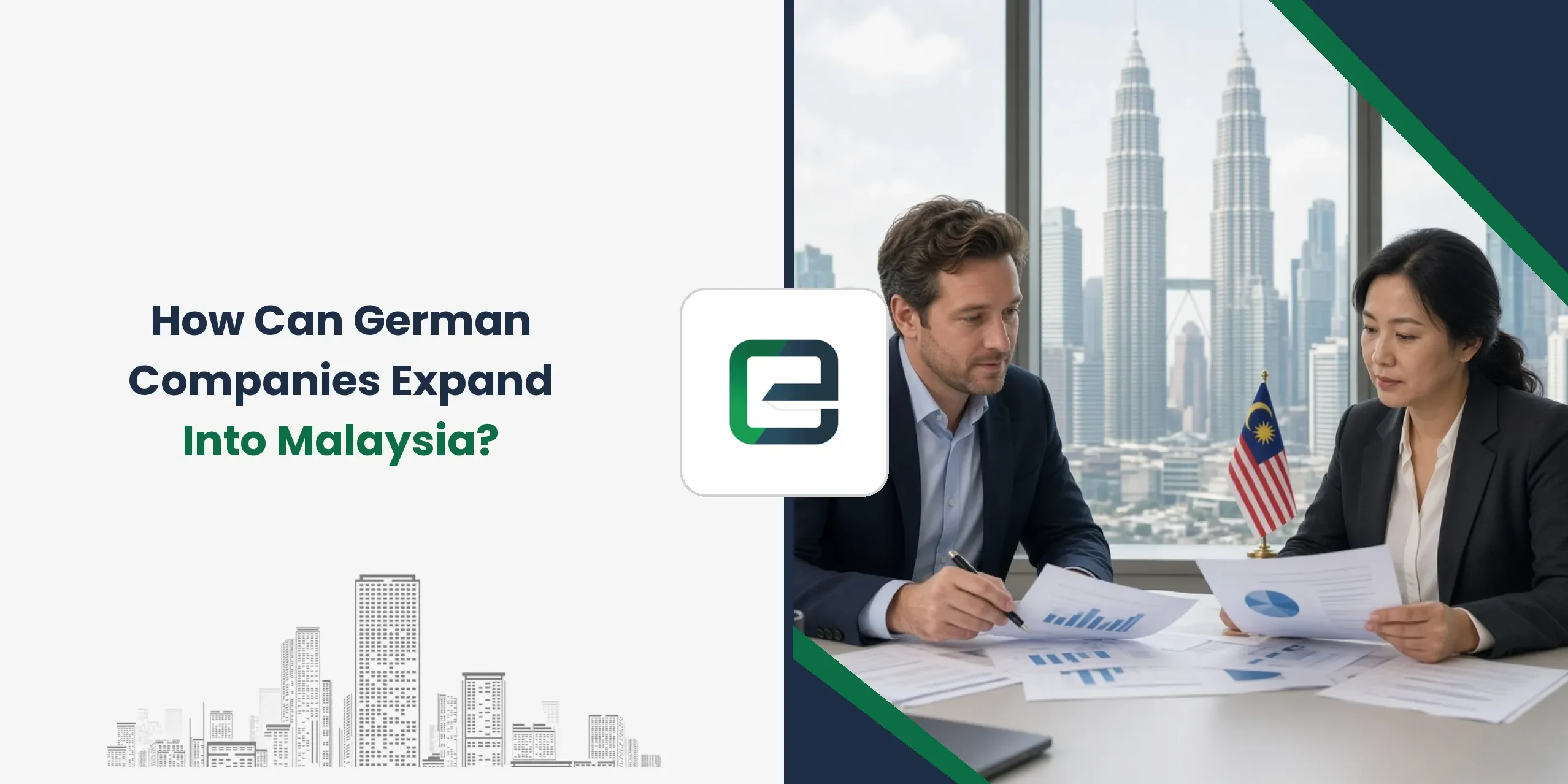
What does it really take to move a German business into Southeast Asia without surprises on fees, capital and licences? Companies from Germany expanding into Malaysia can register a wholly owned company with RM1 paid-up capital, subject to other requirements.
In this guide, we discuss market entry routes for companies from Germany and SSM fees for 2026. We explain capital thresholds, licensing, work passes and the compliance calendar after setup. This helps your board budget with confidence instead of guesswork.
What Should German Companies Expanding Into Malaysia Know Before Entering?
Before entering, German companies should know Malaysia offers:
- a manufacturing-strong economy,
- ASEAN market access,
- a familiar company law framework,
- the Companies Commission of Malaysia (SSM) as the single registration gateway.
Germany has long ranked among Malaysia's most important European trading and investment partners. German engineering, automotive and industrial technology groups operate across the country's manufacturing hubs. For a mid-sized enterprise weighing its first Southeast Asian base, the question is rarely whether Malaysia is viable. It is which structure fits.
The legal starting point is the Companies Act 2016, which SSM administers. A foreign parent may incorporate a local private limited company (Sendirian Berhad, or Sdn Bhd). It may hold full foreign ownership in most sectors. It also needs at least one resident director and a registered office address. The Malaysian Investment Development Authority (MIDA) facilitates investment incentives for qualifying projects; new manufacturing applications use the New Incentive Framework, which offers a special tax rate or an investment tax allowance.
This combination explains why the country remains a launchpad for multinational companies in Malaysia serving the wider ASEAN region. Preferential trade agreements, including the Regional Comprehensive Economic Partnership (RCEP), can give Malaysian-based production tariff advantages across Asia-Pacific markets. This applies only when the goods meet the applicable rules of origin and any other conditions of the agreement.
Which Market Entry Route Should Your Company Choose?
Most German groups choose between a local Sdn Bhd subsidiary, a registered foreign company (branch) and a representative office, depending on liability appetite and commercial purpose.
The right structure depends on whether you intend to trade, hire and sign contracts in your own name, or simply study the market before committing capital. Each route carries different fees, liability exposure and regulatory obligations.
For branches, the process is set out in SSM's guidelines for registration of foreign company. Name approval comes first, followed by submission of shareholder, director and constitution details within 30 days. The branch must carry the same name as your registration in Germany, and a Malaysian resident agent must be appointed.
1. Local Sdn Bhd Subsidiary
A subsidiary is a separate legal entity in which your German parent can hold all the shares. The parent’s liability as a shareholder is generally limited to any unpaid amount on its shares, although guarantees can create additional liability; incorporation costs a flat RM1,000, and the subsidiary is a standard vehicle for trading, hiring and distribution.
2. Foreign Company (Branch)
A branch carries your German company's name and the parent remains liable for its obligations. Registration fees under section 562 of the Companies Act 2016 are tiered from RM5,000 to RM70,000 based on share capital converted to ringgit. A flat RM70,000 applies if the company has no share capital.
3. Representative Office
A representative office may conduct market research, liaison and coordination, but it cannot earn revenue. It suits groups still testing demand before committing paid-up capital.
Malaysia Market Entry Advantages for German Companies
| Factor | What It Means for Your Business |
|---|---|
| Manufacturing ecosystem | Established electrical and electronics, chemicals and machinery supply chains that complement German engineering exports |
| ASEAN and RCEP access | Production in Malaysia may qualify for preferential tariffs across Southeast Asia and wider Asia-Pacific markets |
| Familiar legal framework | The Companies Act 2016 provides separate legal personality and limited liability protection, with English-language filings |
| Cost competitiveness | Lower operating and talent costs than regional financial hubs, with strong infrastructure and English widely used in business |
| Investment incentives | MIDA facilitates qualifying incentives; new manufacturing applications use the New Incentive Framework’s special tax rate or investment tax allowance |
How Much Does It Cost to Incorporate a Local Sdn Bhd in Malaysia?
A standard local incorporation costs a flat RM1,000 statutory fee, plus RM50 for each 30-day name reservation if you want to secure a name first.
Before filing, confirm what the Companies Act 2016 requires and what SSM will accept. A private company can be incorporated with RM1 in paid-up capital, although sectoral, licensing and immigration requirements may require more. The practical sequence we run for clients from Germany is set out below.
SSM's table of fees confirms the 2026 statutory figures: RM1,000 for incorporation and RM50 per 30 days for name reservation. In practice, professional support brings a realistic first-year estimate of RM4,500 to RM13,000. This estimate covers document preparation, registered office and secretarial setup, based on our working capital planning for foreign founders.
Our Malaysia company incorporation services cover this end-to-end sequence, including pre-filing checks on business activity codes that affect licensing later.
The core requirements include:
- at least one shareholder, who can be your German parent company;
- at least one director who is at least 18 years old and ordinarily resides in Malaysia;
- a registered office address in Malaysia; and
- a company secretary holding a valid SSM practising certificate, appointed within 30 days of incorporation and notified to SSM within a further 14 days.
The incorporation sequence is:
- Reserve your company name with SSM (RM50 per 30 days, extendable up to 180 days) — this is optional, as direct incorporation is allowed.
- Lodge the incorporation application under section 14 of the Companies Act 2016 with the RM1,000 fee.
- Appoint a qualified company secretary and notify SSM within the statutory window.
- Open a corporate bank account, check the company’s automatically issued tax identification number, complete any other applicable tax registrations and apply for sectoral licences.
Comparing Market Entry Routes in Malaysia
| Entry Route | Legal Liability | Statutory Fee (RM) | Best Suited For |
|---|---|---|---|
| Sdn Bhd subsidiary | Separate legal entity; shareholder liability is generally limited, but guarantees can create additional exposure | 1,000 flat | Long-term trading, hiring and distribution |
| Foreign company (branch) | Parent remains liable; must carry the same name as in Germany | 5,000 – 70,000, tiered by share capital in ringgit | Contract fulfilment, construction or tender work under the parent's name |
| Representative office | No revenue-generating activity permitted | Approval-based; no share capital | Feasibility studies before committing capital |
How Much Paid-Up Capital Will Your Structure Require?
SSM accepts RM1 on paper. ESD registration and licences can require more, depending on ownership and activity.
Bank relationship managers, the Expatriate Services Division (ESD) of the Immigration Department and licensing ministries each apply their own capital floors. Budget for the structure you actually intend to run, not the statutory minimum.
Companies from Germany sponsoring expatriate staff must check the applicable registration route and capital threshold. ESD sets its registration threshold at RM250,000 for a wholly local company. It is RM350,000 for a joint venture with at least 30% foreign equity, and RM500,000 for a wholly foreign-owned company. ESD generally requires RM1,000,000 for foreign-majority WRT businesses and certain unregulated services businesses. The paid-up capital table under the licences section summarises the main thresholds. MIDA-related applications follow the MIDA Expatriate System.
Where your parent lends to the subsidiary instead of injecting equity, transfer pricing rules under LHDN's guidelines come into play. Capitalisation should be planned alongside your corporate structure, not after the bank account is opened.
Key SSM Fees for Companies From Germany (2026)
| Item | Fee (RM) | Notes |
|---|---|---|
| Name reservation | 50 per 30 days | Optional; extendable up to 180 days |
| Sdn Bhd incorporation | 1,000 flat | Application under section 14 of the Companies Act 2016 |
| Branch registration | 5,000 – 70,000 | Tiered by share capital converted to ringgit; RM70,000 flat if no share capital |
| Annual return – private company | 150 | Lodged under section 68 |
| Annual return – public company | 500 | Lodged under section 68 |
Which Licences and Work Passes Might Your Business Need?
Beyond SSM registration, the three approvals that most often apply to German investors are the WRT licence, ESD registration for Employment Passes and sectoral regulator approvals.
Licences depend on your business activity code, shareholding structure and whether you distribute goods locally. Plan them before incorporation, because paid-up capital and headcount approvals interact with each other.
1. WRT Licence for Distributors and Retailers
A foreign-majority wholesale, retail or distribution company may need WRT approval from the Ministry of Domestic Trade and Cost of Living. ESD generally requires RM1,000,000 paid-up capital for these companies seeking expatriate registration.
2. ESD Registration and Employment Passes
For ESD registration, a wholly foreign-owned company generally needs RM500,000 in paid-up capital. A qualifying joint venture needs RM350,000, while a wholly local company needs RM250,000. Higher thresholds apply to certain activities. From 1 June 2026, MIDA-related applications use the MIDA Expatriate System rather than ESD Online.
3. Sectoral Approvals and Incentives
Financial services fall under Bank Negara Malaysia, manufacturing incentives under MITI and MIDA, and technology companies may pursue Malaysia Digital status with MDEC. Confirm which regulator governs your activity before filing.
Paid-Up Capital Thresholds by Ownership Structure
| Structure | Minimum Paid-Up Capital (RM) | Driver |
|---|---|---|
| Basic local company | 1 | Possible paid-up capital; sectoral requirements may be higher |
| Wholly local company | 250,000 | ESD registration threshold |
| Joint venture with 30% or more foreign equity | 350,000 | ESD registration threshold |
| Wholly foreign-owned services company, Employment Pass | 500,000 | Immigration Expatriate Services Division norms |
| Foreign-majority trading business | Varies | KPDN’s shareholders’ funds requirements depend on the trade format; ESD generally requires RM1,000,000 paid-up capital for foreign-owned WRT companies seeking registration |
Annual Compliance and Lodgement Fees (2026)
| Obligation | Fee (RM) | Governing Provision |
|---|---|---|
| Annual return – private company | 150 | Section 68, Companies Act 2016 |
| Annual return – public company | 500 | Section 68, Companies Act 2016 |
| Financial statements – private company, audited | 50 | Section 259, Companies Act 2016 |
| Financial statements – public company | 200 | Section 259, Companies Act 2016 |
| Branch financial statements | 200 | Section 575, Companies Act 2016 |
| Branch annual return | 500 | Section 576, Companies Act 2016 |
What Ongoing Compliance Obligations Apply After Setup?
Expect an annual return, financial statements lodgement, secretarial maintenance and tax filings — with SSM lodgement fees ranging from RM20 to RM500 depending on entity type.
SSM requires a private company to lodge its annual return under section 68 within 30 days of its incorporation anniversary, and its financial statements under section 259 within 30 days after circulation to members. Branches file their home-country financial statements and an annual return as a foreign company, at higher fees.
On the tax side, the Inland Revenue Board (LHDN) administers corporate income tax and the phased e-invoicing rollout. Your corporate income tax return is due within seven months after the financial year end. LHDN also oversees transfer pricing documentation for related-party transactions with your German parent. Malaysia and Germany also have a double taxation agreement, which helps prevent the same profits being taxed twice.
Instruments such as share transfer forms and certain contracts must be stamped through the e-Stamping process. If you are unsure which deadlines apply to your entity, reach out through our contact page and we will map the compliance calendar for you.
Conclusion
Companies from Germany expanding into Malaysia typically choose a wholly owned Sdn Bhd subsidiary. A realistic first-year setup budget is RM4,500 to RM13,000. Paid-up capital depends on ownership, activity and expatriate requirements. ESD thresholds include RM250,000 for a wholly local company, RM350,000 for a qualifying joint venture and RM500,000 for a wholly foreign-owned company. Certain activities require RM1,000,000. Companies should also plan an annual SSM and LHDN compliance calendar. A branch suits niche contract work, while a representative office buys time before commitment.
As a Corporate Services Provider, we help parent companies from Germany incorporate, appoint secretaries, register for tax, secure licences and stay compliant. We are backed by the 3E Accounting International Network, spanning more than 110 countries. Technology-enabled processes give you a single point of coordination between your headquarters and the Malaysian entity.
If your board is weighing a Malaysian subsidiary, branch or representative office, talk to us early. The structure you pick determines your fees, capital and visa outcomes — and we can map all three before you commit.
Ready to Plan Your Malaysian Expansion?
Whether you need a subsidiary, a branch or simply a feasibility assessment, the earlier the structure is mapped, the smoother the entry. Talk to 3E Accounting Malaysia about your market entry plan.
Frequently Asked Questions
Yes. Foreign investors may hold all shares in a local Sdn Bhd in most sectors, provided there is at least one director ordinarily residing in Malaysia and a local registered office address.
SSM charges a flat RM1,000 to incorporate a private company in 2026, plus RM50 per 30 days if you reserve a name first. A realistic first-year outlay including professional services runs from RM4,500 to RM13,000.
No. Branch registration fees start at RM5,000 and rise to RM70,000 based on share capital, while a subsidiary costs a flat RM1,000 and limits the German parent's liability.
Yes. Every company must appoint a secretary holding a valid SSM practising certificate within 30 days of incorporation, and notify SSM within a further 14 days.
SSM accepts RM1, but expatriate registration can require more. ESD generally requires RM250,000 for a wholly local company, RM350,000 for a qualifying joint venture and RM500,000 for a wholly foreign-owned company. Certain foreign-majority trading and unregulated services businesses need RM1,000,000.

Abigail Yu
Director
Abigail Yu oversees executive leadership at 3E Accounting Group, leading operations, IT solutions, public relations, and digital marketing to drive business success. She holds an honors degree in Communication and New Media from the National University of Singapore and is highly skilled in crisis management, financial communication, and corporate communications.