
In Malaysia, a partial customer refund can still be corrected after an e-invoice is validated. Once 72 hours pass from validation, not the invoice date or complaint, use the adjustment route.
In this guide, our team at 3E Accounting Malaysia explains how to approach this correction after 72 hours. We cover document choices, MyInvois references, journal entries and Sales and Service Tax (SST) checks. All amounts and scenarios below are illustrative, not client records, and nothing here is pre-approved advice for a specific transaction.
Why Does the 72-Hour Window Matter for a Malaysia E-Invoice Partial Refund?
Inside 72 hours of validation, an eligible buyer can request rejection and the supplier can cancel an erroneous e-invoice, subject to system conditions; foreign purchasers outside MyInvois cannot request rejection through the system.
The Inland Revenue Board of Malaysia (LHDN), known in Malay as Lembaga Hasil Dalam Negeri Malaysia (HASiL), is rolling out e-invoicing in phases. Under the implementation timeline in force at the time of writing, taxpayers above RM100 million in annual turnover began in August 2024. Taxpayers with turnover above RM25 million and up to RM100 million followed in January 2025; those above RM5 million and up to RM25 million followed in July 2025; the phase for taxpayers up to RM5 million began in January 2026, subject to exemptions and rules for newer businesses.
HASiL exempts eligible taxpayers with annual turnover or revenue below RM3 million, subject to conditions including those concerning certain shareholders, holding companies, related companies and joint ventures. A home-based business in Malaysia should check the detailed eligibility conditions rather than assume exemption. Other businesses should check their implementation dates. Guidance checked: 1 November 2026; technical and SST review remains outstanding. That includes owner-managed SMEs and multinational companies in Malaysia alike, along with newer companies set up through company registration services in Malaysia.
HASiL's framework sets a 72-hour window that starts at validation. Inside it, the buyer may request rejection and the supplier may cancel the document. Two points our team makes immediately: a rejection request from the buyer does not by itself cancel the invoice, and adjustment documents are allowed inside the window as well. HASiL's e-invoice guidance on its portal describes both routes.
After 72 hours, cancellation and rejection are no longer the standard path. The correction moves to an adjustment document that references the original. That is why the reason for repayment — not the invoice date — drives what you issue next.
Refund Note, Credit Note or Debit Note: Which Document Fits a Partial Refund?
Match the document to the transaction. A refund of the buyer's payment generally calls for a refund note, while a reduction without repayment calls for a credit note; exceptions include mistaken payments, overpayments and returned security deposits. An additional charge calls for a debit note.
These distinctions come from the document-type definitions in HASiL's MyInvois framework. Our team applies them to the actual transaction, not to the label a salesperson used.
A refund note confirms money returned to the buyer. A credit note reduces an invoice where money is not returned. A debit note records an additional charge.
One caution: never issue a credit note and a refund note for the same amount as two independent reductions. A partial refund is one economic event, and it should appear once.
Also check any adjustment already issued before assuming every payment to a customer is a refund of the original sale. The money could be compensation, a returned overcollection, or the settlement of a separate credit. The definitions only help once they are mapped to the real transaction.
Adjustment Documents Under the MyInvois Framework
| Document | What it evidences | When it typically applies |
|---|---|---|
| Refund note | Money returned to the buyer | Partial or full repayment of a previously validated sale |
| Credit note | A reduction in the invoice with no money returned | Price reduction retained as customer credit or offset against future supply |
| Debit note | An additional charge to the buyer | Under-billed amounts or post-invoice supplementary charges |
| Cancellation | Change of the document's status to cancelled within 72 hours of validation | A genuine error where the transaction will be re-issued or reversed; the cancelled document remains retrievable. |
How Should a Refund Note Reference the Original Invoice in MyInvois?
The refund note should reference the original validated e-invoice. The version 1.1 schema specifies the original UUID and internal invoice number where applicable.
The universally unique identifier (UUID) is what ties the adjustment to the original submission. The internal invoice number ties it to your own records. Both travel in fields the schema reserves for them, so the technical step is to confirm which schema version your submitting system supports. The MyInvois SDK documentation sets out the structures for each document type.
For refund notes, versions 1.0 and 1.1 use the same structure, but version 1.1 enables digital-signature validation. It does not turn a cash refund into a credit note — the document logic and the technical format are separate questions.
Before issuing, confirm the customer's details. For a corporate buyer, a company search against the official register confirms the registered name and number you are referencing.
One more check from HASiL's frequently asked questions: where the original invoice predates e-invoicing, the treatment of the reference differs. Confirm the original document's date rather than assuming one route fits all.
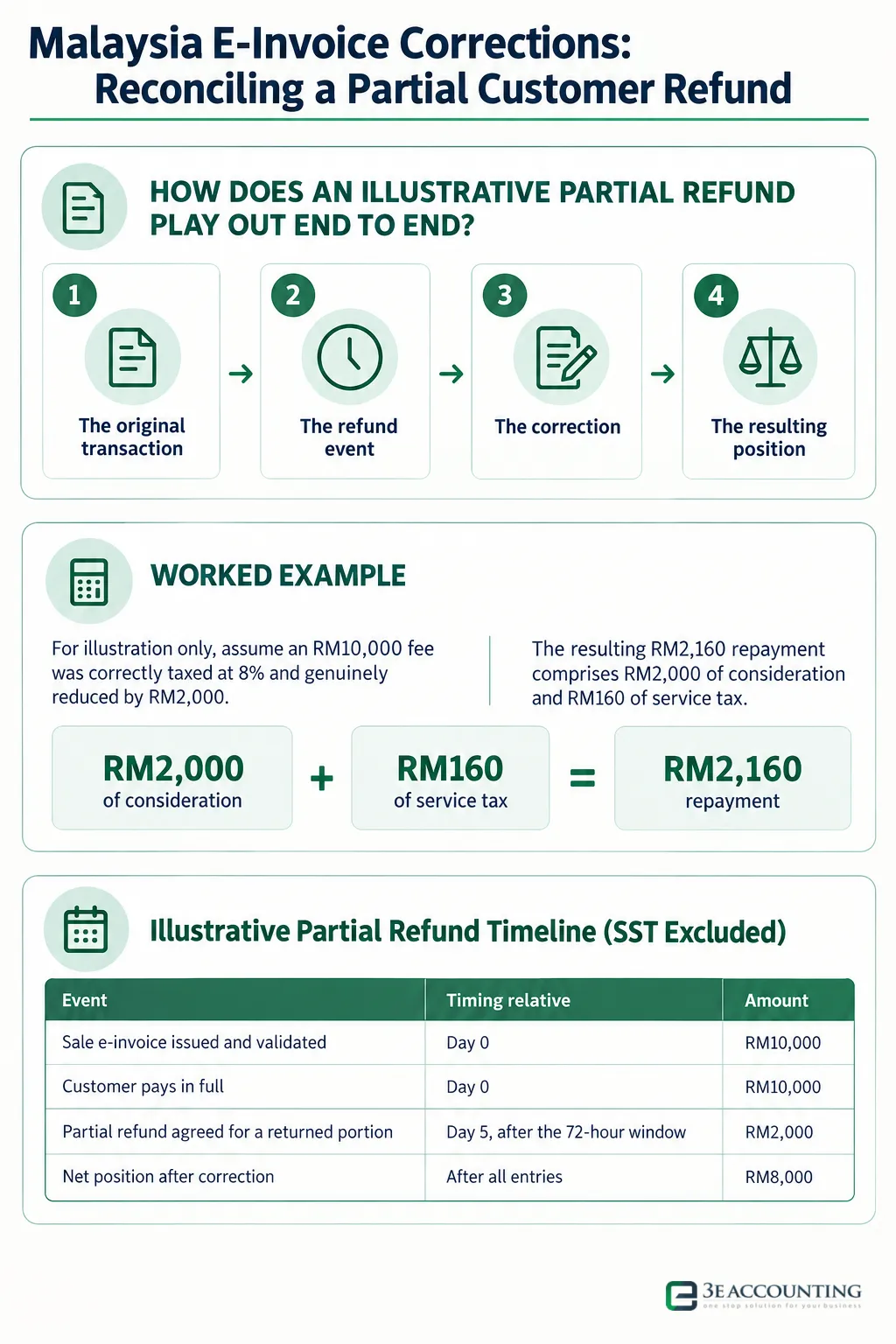
How Does an Illustrative Partial Refund Play Out End to End?
Assume a non-client sale of RM10,000, excluding SST, and a RM2,000 refund five days after validation. Our team's proposed approach is one RM2,000 refund note, leaving RM8,000 in revenue and cash. The original invoice remains traceable.
The amounts, timing and entries below are assumptions our team uses to walk through the mechanics. They are not drawn from any client record. The figures, timing and proposed treatment still need technical review. Treat them as a worked pattern to confirm against your own facts.
1. The original transaction
A supplier issues an e-invoice for RM10,000 and submits it for validation. The customer then pays the full RM10,000.
2. The refund event
Five days later, beyond 72 hours from validation, the parties agree to refund RM2,000 for a returned portion. The refund genuinely reduces the consideration for the sale.
3. The correction
The supplier issues a refund note e-invoice for RM2,000, referencing the original validated e-invoice. The original is not cancelled: the window has passed and the remaining sale continues.
4. The resulting position
The original RM10,000 sale remains in the audit trail. The adjustment is RM2,000. Retained revenue and retained cash are RM8,000. Nothing is reduced twice.
Illustrative Partial Refund Timeline (SST Excluded)
| Event | Timing relative to validation | Amount | e-Invoicing action |
|---|---|---|---|
| Sale e-invoice issued and validated | Day 0 | RM10,000 | Original e-invoice submitted to MyInvois |
| Customer pays in full | Day 0 | RM10,000 | Bank receipt matched to the customer account |
| Partial refund agreed for a returned portion | Day 5, after the 72-hour window | RM2,000 | Refund note issued, referencing the original e-invoice |
| Net position after correction | After all entries | RM8,000 | Revenue and cash retained; original remains in the audit trail |
What Are the Journal Entries for a Partial Customer Refund in Malaysia?
Post the correction once: debit a revenue-reduction account and credit the customer, then clear that credit with the bank repayment. Revenue is not touched again when the cash leaves.
Under the assumptions above, and with SST excluded, the entries run as follows. Account names should follow your own chart of accounts. The entries assume proper initial revenue recognition, full payment, no prior refund liability and a genuine sales reduction. They also assume no recovery asset was previously recognised. IFRS 15 may require a refund liability and a separate recovery asset for a sale with a right of return. A saleable returned item might be restored to inventory against cost of sales, depending on prior entries and recoverability. These entries and account names need review under the applicable MFRS or MPERS framework.
Step 1: Recognise the sale
Debit trade receivables RM10,000 and credit sales RM10,000. This records the customer's receivable and the original sale, assuming revenue recognition is appropriate.
Step 2: Record the payment
Debit bank RM10,000 and credit trade receivables RM10,000. The customer account clears on the original sale.
Step 3: Post the refund adjustment
Debit sales returns, or your chosen revenue-reduction account, RM2,000. Credit the customer's receivables account RM2,000. This creates a customer credit of RM2,000.
Step 4: Repay the customer
Debit the customer's account RM2,000 and credit bank RM2,000. The credit clears, and revenue is not debited a second time.
Step 5: Reconcile the event
Keep one reconciliation record that ties the following together:
- The original e-invoice's internal number and UUID
- The refund note's internal number and UUID
- The internal approval for the refund
- The bank payment reference for the repayment
The final check is that the validated refund note, the customer-account adjustment and the bank repayment describe the same RM2,000 event — not three separate adjustments. This is our proposed workflow, not a documented internal procedure, and not every item in it is mandated by HASiL.
Illustrative Journal Entries for a Partial Refund
| Entry | Debit | Credit | Amount |
|---|---|---|---|
| Original sale | Trade receivables | Sales | RM10,000 |
| Payment received in full | Bank | Trade receivables | RM10,000 |
| Refund adjustment | Sales returns | Trade receivables | RM2,000 |
| Cash repayment to customer | Trade receivables | Bank | RM2,000 |
Where Do Partial Refunds Go Wrong in Practice?
The two failure modes our team looks for first are a duplicated revenue reduction and a bank repayment with no validated adjustment behind it.
Both examples below are hypothetical composites, not cases this firm has handled or recorded. In a Malaysia e-invoice partial refund review, the portal, the ledger and the bank must tell one story; the right correction depends on the transaction and the entries already made.
1. The double reduction
In an illustrative composite, a customer pays RM10,000 and later receives RM2,000 back. A bookkeeper posts the repayment straight to sales returns. Separately, the invoicing system imports the refund note and posts another RM2,000 reduction.
The bank correctly shows RM8,000 in net receipts. But revenue shows RM6,000, and the customer ledger carries an unexplained credit. The correction is to reverse the duplicate accounting entry and allocate the bank repayment against the customer credit the refund note created. The valid refund note is never deleted to force the numbers to agree.
2. The unvalidated adjustment
The second risk is a bank refund supported only by an internal credit memo, with nothing validated in MyInvois. The bank statement, the accounting records and the e-invoice record then cannot be tied to one another.
The fix is to issue the appropriate refund note referencing the original e-invoice, then match it to the existing accounting entry. The reduction is not posted a second time.
When Does a Partial Refund Require an SST Adjustment in Malaysia?
A repayment does not automatically reduce SST already accounted for. The tax position turns on the supply, the tax charged, the reason for the repayment, and whether the tax has been declared or paid.
Our first step is to establish what was supplied and whether it fell within Sales and Service Tax at all. The Royal Malaysian Customs Department (RMCD) administers SST. It prescribes service-tax credit-note particulars and lists different rates for different services.
For illustration only, assume an RM10,000 fee was correctly taxed at 8% and genuinely reduced by RM2,000. The resulting RM2,160 repayment comprises RM2,000 of consideration and RM160 of service tax. The figures, service classification and rate assumption still need specialist review. Our team would not apply an 8% rate indiscriminately to every supply. The arithmetic alone does not establish eligibility to deduct tax, or its timing.
RMCD's service-tax guidance describes a deduction route for tax already paid and refunded. It requires advance Director General approval and describes a one-year period, subject to any approved extension. These service-tax conditions should not automatically be applied to sales tax. Which route applies—an SST-02 credit-note adjustment or an approved deduction of service tax already paid and refunded—is a specialist determination; the deduction is also made through SST-02.
Two boundaries matter. A validated MyInvois refund note does not by itself establish a right to reduce SST already accounted for. And whether one combined document, or linked documents, can satisfy both regimes is not settled by the guidance — that arrangement needs specialist confirmation before anyone relies on it.
SST Checks Before Finalising a Partial Refund
| Check | Why it matters |
|---|---|
| Was the original supply within SST at all? | Determines whether any tax adjustment exists |
| What rate and tax point applied? | Drives the tax component of any repayment |
| Why is money being returned? | Returned goods, cancelled services, overcollection and compensation are treated differently |
| Has the tax been declared or paid? | Determines whether you adjust a return or claim a deduction |
| Which RMCD documentation route applies? | Credit-note particulars and deduction conditions differ, including approval and timing requirements |
When Would the Recommended Approach Change?
The document logic holds steady, but the amount, the timing, an earlier credit note, the schema version and the customer's location can each change the path.
A partial refund is not a single fact pattern. These are the branch points that most often change our recommendation.
1. A full refund instead of a partial one
The amount changes, not the route. After the window, a refund note for the full value reverses the economics while the original stays in the audit trail. A full refund changes the amount; it does not automatically require cancellation.
2. The refund lands within 72 hours
Cancellation becomes available, but our team reserves it for a transaction that should genuinely be cancelled or replaced. Cancelling a whole sale to document a partial return would misstate the continuing transaction, unless a corrected replacement e-invoice is also issued.
3. The reduction is retained as customer credit
Where the price falls but the money stays as credit for future supply, the credit-note route fits. If a previously credited amount is later paid out in cash, review the existing adjustment first, so the payment does not create a second reduction of revenue or tax.
4. A credit note was issued before the cash refund
Our team would review the existing credit note before recommending a correction. The clean-up sequence needs technical and SST review, including document references, cancellation eligibility, accounting-system effects and tax consequences. It should not be treated as settled before that review.
5. The customer is overseas
Start from the same refund-note-versus-credit-note distinction. Our team would also review the foreign buyer's details, invoice currency, exchange differences and the supply's SST treatment. Cross-border cases warrant specialist review before detailed advice is given.
Conclusion
Handled properly, a partial refund after 72 hours comes down to three moves. Confirm the window has run from validation, not from the invoice date. Issue the document that matches the cash — a refund note where money is returned — referencing the original validated e-invoice. Then post the adjustment once and reconcile the customer account, the bank and the portal to a single event.
The SST position is a separate question from the HASiL paperwork, and it deserves its own review before anything is filed. Where returns interact with revenue recognition, the accounting judgement belongs under the reporting framework that applies to you, not under a worked example.
3E Accounting Malaysia is a Corporate Services Provider supporting local SMEs and multinational companies with incorporation, corporate secretarial, accounting, tax and advisory services. Our Corporate Professional Advisors help businesses design e-invoice adjustment workflows, untangle mismatches between ledgers and MyInvois, and put SST positions in front of the right specialist. If a partial refund has left your records telling different stories, talk to our team.
Need a second pair of eyes on an e-invoice adjustment?
Share the scenario with our team and we will review the documents, the ledger entries and the tax position with you.
Frequently Asked Questions
Generally no. Once 72 hours have passed from validation, the cancellation and rejection route has closed, and the correction is made through an adjustment document that references the original — typically a refund note where money is returned. Adjustments are also permitted inside the window.
Issue a refund note where money is actually returned to the customer. Use a credit note where the invoice is reduced without money being returned, such as a price reduction retained as customer credit. Never issue both documents for the same amount as two independent reductions.
Use the reference fields the applicable schema provides. Under the refund note version 1.1 structure, these include the original validated e-invoice UUID and your internal invoice number where applicable. Check the schema version your submitting system supports, and note that HASiL treats invoices issued before e-invoicing differently.
Debit a revenue-reduction account, such as sales returns, and credit the customer's receivables account. When the money is repaid, debit the customer account and credit bank. Revenue is reduced once; the bank payment clears the customer credit.
No. The SST treatment depends on what was supplied, the tax charged, why the money is returned, and whether the tax has already been declared or paid. RMCD prescribes credit-note particulars and sets conditions on deducting tax already paid, so the tax side needs its own specialist review.

Abigail Yu
Director
Abigail Yu oversees executive leadership at 3E Accounting Group, leading operations, IT solutions, public relations, and digital marketing to drive business success. She holds an honors degree in Communication and New Media from the National University of Singapore and is highly skilled in crisis management, financial communication, and corporate communications.