
In Malaysia, a late e-Invoice request may arrive after month-end. The Inland Revenue Board of Malaysia (LHDN) may already have validated the consolidation, making duplicate reporting a risk.
In this article, we explain the e-Invoice rules and an optional credit-note-and-reissue route. Our tax team also explains controls that help keep the original sale counted once. Every worked figure is illustrative, and the rules cited reflect guidance in force as at November 2026.
When Can a Buyer Ask for an Individual e-Invoice?
The window is the transaction month: a buyer who receives a receipt may request an individual e-Invoice within that month, and a supplier may decline a request that arrives afterwards.
Version 4.9 of the e-Invoice Specific Guideline published by LHDN sets this out in section 3.6.8 and illustrates it in example 5. The buyer's right to ask is tied to the transaction month of the receipt, not to any later period. Two qualifications matter in practice, and they shape everything that follows.
A late request must also be distinguished from interim relief. LHDN has granted phased relaxation to certain turnover cohorts. Applicable relief may permit consolidation without an individual e-Invoice, even when one is requested.
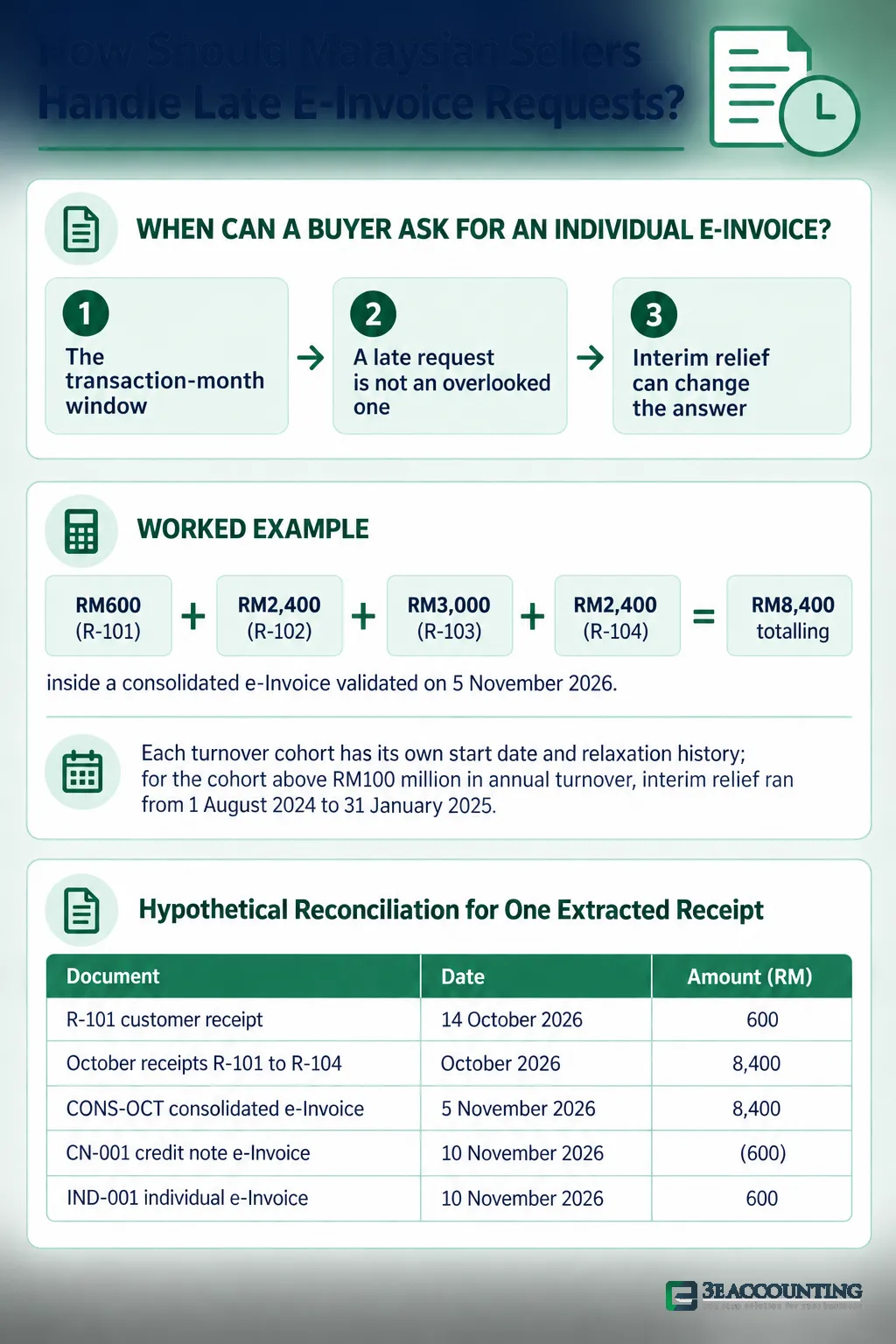
1. The transaction-month window
The buyer who receives an ordinary receipt may request an individual e-Invoice during the transaction month. A request made after month-end may be declined. Applicable interim relief and timely requests overlooked by the seller need separate consideration.
2. A late request is not an overlooked one
If the buyer asked in time and the seller missed it, the correction belongs to the seller's own error process. The first fact to establish is always when the request actually reached the seller.
3. Interim relief can change the answer
Phased relaxation has applied differently across turnover cohorts. The applicable relief on the transaction date should be confirmed before any request is declined as late.
What Are the Rules on Consolidated e-Invoices in Malaysia?
Where eligible receipts attract no individual request, a supplier may aggregate the month's transactions and submit one consolidated e-Invoice within seven calendar days after month-end.
Section 3.6.2 of the Specific Guideline allows monthly aggregation where buyers do not require individual e-Invoices, across business, consumer and government transactions. The consolidated document is issued to General Public rather than to a named buyer, and it must reach LHDN within seven calendar days after month-end. That deadline is separate from the buyer's request window and from any cancellation window.
Consolidation is not universal. Section 3.7 excludes specified activities and, from 1 January 2026, single transactions strictly above RM10,000 from consolidation; section 16 sets out the applicable interim relaxation. Applicable interim relief can permit consolidation instead. Where annual gross takings exceed RM150,000 for goods or services, serially numbered receipts must be issued; their reference numbers are generally included in the consolidated submission, but applicable interim relaxation permits other information in the description field.
The obligation itself is phased. Taxpayers with annual turnover or revenue up to RM5 million fall within the 1 January 2026 phase, but some have a 1 July 2026 concessionary implementation date; taxpayers below RM3 million may be exempt if they meet the exemption criteria. LHDN's current FAQs, updated in September 2026, put the penalty for failing to issue at a fine between RM200 and RM20,000, imprisonment of up to six months, or both. If you are still completing the steps to incorporate your business in Malaysia, confirm your cohort before assuming any deadline, and cross-check the neighbouring dates in our Malaysia statutory filing calendar.
1. Seven calendar days after month-end
The consolidated e-Invoice wraps up the month's eligible receipts in one validated document. Because it is issued to General Public, it is not a document the individual buyer holds.
2. Transactions that cannot be consolidated
Excluded activities and, from 1 January 2026, single transactions strictly above RM10,000 generally require individual e-Invoices, even without a request. Applicable interim relief can permit consolidation instead. A sale that was never eligible is a compliance question, not a service gesture.
3. Phasing, exemptions and interim relief
Each turnover cohort has its own start date and relaxation history; for the cohort above RM100 million in annual turnover, interim relief ran from 1 August 2024 to 31 January 2025. Always check the relief in force on the transaction date.
Key e-Invoice Deadlines and Limits in Malaysia (2026)
| Rule | Requirement | Source |
|---|---|---|
| Buyer's request window | Individual e-Invoice may be requested within the transaction month | Specific Guideline s.3.6.8 |
| Consolidated submission | Within 7 calendar days after month-end | Specific Guideline s.3.6.2 |
| Single-transaction exclusion | Strictly above RM10,000 generally cannot be consolidated, from 1 January 2026; applicable interim relief may permit consolidation | Specific Guideline s.16 |
| Cancellation window | 72 hours from validation | e-Invoice Guideline s.2.3.6 |
| Failure to issue | Fine of RM200 to RM20,000 and/or up to 6 months' imprisonment | Income Tax Act 1967, s.120(1)(d) |
How Do You Issue an Individual e-Invoice After a Consolidated One?
The route LHDN illustrates is a pair of documents: a credit note e-Invoice that reduces the consolidated submission, followed by a new individual e-Invoice to the buyer.
LHDN's illustrative material, at illustration 4, shows a seller accommodating a request received after consolidation. The seller issues a credit note e-Invoice against the consolidated document, extracting the receipt concerned, and then issues the individual e-Invoice for that receipt. The route is optional: it is a commercial accommodation subject to the seller's internal policy, not a duty the buyer can enforce.
Two technical points deserve care. The credit note must carry the original document's identifier in the Original e-Invoice Reference Number field, exactly as any adjustment to a validated e-Invoice would. And because the consolidated document was issued to General Public, the credit note is addressed consistently, while the replacement carries the buyer's actual particulars. Our working habit is to confirm the current field mapping in the MyInvois specification before transmission.
Step 1: Verify the facts
Check the receipt and whether it was eligible for consolidation. Confirm validation status and timestamp, and check whether an individual e-Invoice already exists. A duplicate is the one error this route must never produce.
Step 2: Collect particulars and approvals
Establish the buyer's category, validate the identification particulars supplied, and use the MyInvois validation facilities where a business buyer is involved. Secure internal sign-off before anything is transmitted.
Step 3: Issue the credit note against the consolidated document
The credit note states that a receipt is being extracted for individual invoicing. It is not a refund, a discount or a returned sale, and the file should record that reason.
Step 4: Issue the individual e-Invoice to the buyer
The replacement document carries the buyer's particulars and the original receipt's details. Once validated, send this document to the buyer.
Step 5: Reconcile and retain
Check that the credit and the replacement net to the original sale. A submission acknowledgement is not proof of validation, so retain the validated status of both documents.
Does the 72-Hour Cancellation Window Help Here?
The window allows cancellation of an erroneous document within 72 hours of validation; a later request alone does not make a consolidation erroneous.
Section 2.3.6 of the e-Invoice Guideline allows a supplier to cancel a validated e-Invoice within 72 hours of validation. After that, cancellation is no longer the correction mechanism. An appropriate adjustment document must be considered instead. An adjustment may also be appropriate within the window. The clock starts at validation, not at the sale date and not at the date the buyer writes in, so the validated status and timestamp are the first facts to retrieve.
1. The clock starts at validation
Submission and validation are distinct statuses. Only the validation timestamp starts the 72-hour window, and an acknowledgement of submission proves nothing either way.
2. A valid consolidation is not an error
Cancellation and replacement may be considered within the window if there is a valid reason. A later request alone does not make the consolidation erroneous. Check the operational consequences and replacement deadline before acting.
3. Cancellation is not buyer rejection
Buyers may reject e-Invoices issued to them. A consolidated document issued to General Public is not the individual buyer's document, so asking the customer to reject it is not a route.
Hypothetical Reconciliation for One Extracted Receipt
| Document | Date | Amount (RM) | Role |
|---|---|---|---|
| R-101 customer receipt | 14 October 2026 | 600 | The sale the buyer queries |
| October receipts R-101 to R-104 | October 2026 | 8,400 | Eligible receipts for the month |
| CONS-OCT consolidated e-Invoice | 5 November 2026 | 8,400 | Validated consolidated submission |
| CN-001 credit note e-Invoice | 10 November 2026 | (600) | Extracts R-101 from the consolidation |
| IND-001 individual e-Invoice | 10 November 2026 | 600 | Replacement issued to the buyer |
| Net reported total | — | 8,400 | The sale is counted once |
How Do You Keep the Sale From Being Counted Twice?
The credit note and the replacement must net to zero: whatever the credit removes from the consolidated submission, the individual e-Invoice adds straight back.
The reporting side is simple; duplicates are born on the accounting side. Check whether the point-of-sale (POS) or enterprise resource planning (ERP) system has already posted the month's revenue. The interface must not count that revenue again. Our team's proposed control is to assess reporting-only movements or equal and opposite entries. An accounting reviewer should confirm the connector, journals, receivables, cash, inventory and cost-of-sales effects. Nothing is backdated, and the credit is never described as an actual customer return.
The indirect-tax side needs its own check. Any adjustment must preserve the original tax treatment of the sale, and the tax amounts must reconcile alongside the totals.
1. A hypothetical worked example
Assume four October receipts, R-101 for RM600, R-102 for RM2,400, R-103 for RM3,000 and R-104 for RM2,400, totalling RM8,400 inside a consolidated e-Invoice validated on 5 November 2026. On 10 November, the buyer of R-101 asks for an individual e-Invoice. A RM600 credit note reduces the consolidation and a RM600 individual e-Invoice goes to the buyer. The bridge is RM8,400 less RM600 plus RM600, leaving RM8,400, not RM9,000. All figures, dates, receipts and documents in this example are hypothetical. They are not evidence of an engagement, validation or actual ledger postings.
2. Guard the original sale and payment
The example assumes the October sale and payment remain intact. It also assumes the November extraction has no net revenue effect. An accounting reviewer must confirm the actual system's postings.
3. Reconcile tax amounts as well
The example assumes no Sales and Service Tax (SST) for simplicity. Zero SST is only an illustrative assumption, not a consequence of replacement. A reviewer must determine the actual tax and return treatment.
Which Route Applies When the Request Arrives?
Check request timing and validation status first; the appropriate route also depends on eligibility, relief and the seller's policy.
The decision turns on three dates: the transaction month, the validation timestamp and the moment the request arrived. The table suggests routes for each scenario, including a sale that was never eligible for consolidation.
Before submission, our team's proposed control is to exclude a timely requested receipt from the batch and issue it individually. Check implementation status and applicable interim relief first. If submission is pending validation, check its status before issuing anything else. If validation fails, correct the batch and reassess the request before resubmitting. If it validates, assess the appropriate validated-document route.
One check sits above all of them. Confirm the buyer's category and particulars before issuing anything. A buyer not yet required to implement e-Invoicing is not automatically a General Public buyer. The absence of a buyer's portal account is not the eligibility test.
Request Timing and the Route It Suggests
| When the request lands | Practical route | Key caution |
|---|---|---|
| Before the consolidated submission | Remove the receipt from the batch; issue the individual e-Invoice | Run a duplicate check before either document goes out |
| After validation, within 72 hours | Cancel and replace the consolidation, or proceed by credit note | A valid consolidation is not an error; confirm a genuine cancellation reason |
| After 72 hours | Credit note against the consolidated document, then reissue individually | Cancellation is no longer the correction mechanism |
| Sale never eligible for consolidation | Correct the compliance position, not just the buyer's paperwork | Record it as a compliance exception, not a service gesture |
What Should You Tell the Buyer, and What Should You Keep?
Send the buyer only the validated individual e-Invoice; the consolidated submission and the credit note stay in the seller's own file.
The consolidated e-Invoice contains other customers' transactions and, in the standard route, is issued to General Public. It is not for sharing. A short written explanation helps: the receipt was included in the consolidated submission, an individual e-Invoice will follow using the particulars confirmed, a corresponding adjustment will be made so the sale is reported once, and the exercise is neither a refund nor an additional charge.
If the buyer's finance team later asks whether the credit note means money back, the answer is that it only reallocates the sale from consolidated to individual reporting. Businesses that draw on our corporate tax compliance support often ask us to review this reconciliation before anything is transmitted.
A robust approval chain runs from preparation by the submissions executive, through review by the tax manager, to authorisation by the seller's finance lead. The file should contain:
- the original receipt and its payment evidence
- the buyer's request and the confirmed particulars
- the mapping of the receipt into the consolidated submission
- the original validation identifier and timestamp
- the reason for the adjustment and the approvals given
- the credit note, the replacement e-Invoice and a zero-net-change reconciliation
Conclusion
A late e-Invoice request is not a crisis; it is a routing problem with a documented answer. Confirm the request window has genuinely passed, establish the validation timestamp, and check that the sale was eligible for consolidation in the first place. Where the seller chooses to accommodate a late request, the credit-note-and-reissue route can move the receipt to individual reporting. Reconciliation helps prevent additional revenue being recorded.
As a Corporate Services Provider, 3E Accounting Malaysia can help sellers assess eligibility and buyer particulars. Our team can also assist with adjustment documents, reconciliation and recordkeeping. We consider the guidance applicable to the transaction date.
If a buyer has asked you for an individual e-Invoice after your consolidated submission, speak with our team before issuing anything.
Unsure Which e-Invoice Route Your Sale Needs?
Our tax team can review your consolidated submission, prepare the adjustment documents and reconcile your reporting so every sale counts once.
Frequently Asked Questions
A supplier may decline a request first made after the transaction month. Accommodation is subject to the seller's policy. A timely request the seller overlooked is different. Applicable interim relief can also permit consolidation without an individual e-Invoice, even when requested.
Cancellation is available within 72 hours of validation, and the window runs from the validation timestamp, not the sale date. A valid consolidation does not become erroneous merely because a buyer asks later, so cancelling a large batch needs a genuine reason. After 72 hours, cancellation is no longer available. An appropriate adjustment must be considered; late-request accommodation remains optional.
The credit note reduces the consolidated e-Invoice by the amount of the extracted receipt, and the new individual e-Invoice reports the same amount to the buyer. The reporting movements net to zero. An accounting reviewer must check that the system does not count the sale twice.
No. The consolidated document is issued to General Public and contains other customers' transactions. Send only the validated individual e-Invoice, and keep the credit note, the receipt mapping and the reconciliation in your own file.
From 1 January 2026, a single transaction strictly above RM10,000 is generally excluded from consolidation. Specified activities are also excluded under section 3.7. Applicable interim relief can permit consolidation despite these restrictions. Treat the mistake as a compliance correction and record it as an exception, not as a service gesture.

Abigail Yu
Director
Abigail Yu oversees executive leadership at 3E Accounting Group, leading operations, IT solutions, public relations, and digital marketing to drive business success. She holds an honors degree in Communication and New Media from the National University of Singapore and is highly skilled in crisis management, financial communication, and corporate communications.