
Shopee and Lazada never send your Sendirian Berhad (Sdn Bhd) a tidy monthly sales figure – they send one bank deposit with refunds, vouchers, commissions and advertising already netted off. Proving what sits behind that deposit is the whole point of e-commerce accounting for marketplace sellers in Malaysia.
In this guide, we explain how month-end marketplace payout reconciliation works for a Malaysian Sdn Bhd. We cover:
- the control that links orders, platform settlement and bank receipts;
- ledger accounts that keep deductions visible;
- source files to request;
- a fully hypothetical worked example; and
- the 2026 e-Invoice rules of the Inland Revenue Board of Malaysia (LHDN, widely known as HASiL).
Why Does Malaysia E-Commerce Accounting Never Book the Net Payout as Sales?
Because the payout is a settlement event, not a revenue event: recognise gross sales, post each deduction to its own account, and let a marketplace clearing balance absorb the timing difference.
A month-end pack is strongest when it ties four moving parts into one story, a control design that experienced marketplace practitioners commonly recommend. Treat the structure below as a recommended procedure to adopt, not as documented practice drawn from any firm's client files. The pack should connect:
- order-level activity: recognised sales, cancellations before recognition, refunds and seller-funded vouchers;
- the platform settlement or wallet movement that explains each deduction;
- a marketplace clearing or receivable balance that rolls forward month to month;
- bank receipts, matched to payouts by transaction identifier.
Why not simply post the net deposit as sales? The deposit hides the expenses the platform withheld, confuses settlement timing with revenue timing, and leaves turnover and margin reporting unreliable. Figures that must survive review cannot rest on a net-only close.
The structure is size-agnostic. It works for a one-store home brand and for one of the multinational companies in Malaysia adding a local marketplace channel. A sole proprietor reports differently. The same discipline feeds a personal income tax return. This guide is written for the company seller: the Sdn Bhd registered with the Companies Commission of Malaysia (SSM). Its closed months roll into statutory financial statements and the annual Form e-C corporate tax return.
Which Ledger Accounts Should Capture Marketplace Sales, Fees and Payouts?
One clearing or receivable account carries the timing: merchandise revenue, returns, discounts, shipping, fees and advertising each keep a separate account, and the bank payout simply clears the balance.
The mapping below is a suggested starting point, not a policy. The right treatment for each line depends on your seller contracts, your chart of accounts and the financial reporting framework you apply. Many sellers run a separate clearing or receivable account for each platform, with subaccounts for individual stores where volumes justify them.
Vouchers carry the biggest classification risk. A seller-funded voucher generally reduces your transaction price, so it belongs with seller-funded discounts. A platform-funded subsidy does not automatically reduce your revenue, and any reimbursement due from the platform has to be traced. Who funds each voucher is a question of promotion terms and transaction evidence, not an assumption.
Shipping needs equal care. Post seller-entitled shipping recoveries separately from shipping expense, subject to your contract and your principal-versus-agent assessment. Commission, transaction fees and advertising belong in distinct expense accounts, credited against the clearing account when the platform withholds them. If a platform fee document has already created a payable, the wallet withholding clears that payable instead of creating a second expense.
Advertising needs one further control, and this is a design point rather than a universal platform workflow. Advertising deducted from the settlement wallet belongs inside the settlement bridge; advertising funded from a card needs a separate payment reconciliation against the card account. Verify how your campaigns are actually funded before you map them.
Table 1 sets out the suggested treatment line by line.
Marketplace Settlement Lines and Suggested Ledger Treatment
| Settlement line | Suggested ledger entry | Watchpoint |
|---|---|---|
| Gross order value | Dr marketplace clearing; Cr merchandise revenue | Recognise when earned under your terms, not at order or payout date |
| Cancellation before recognition | No revenue entry | Exclude from the sales population; keep status evidence |
| Refund on recognised sale | Dr sales returns; Cr clearing | Link to the original order; assess earlier provision needs |
| Seller-funded voucher | Dr seller-funded discounts; Cr clearing | Check the promotion terms and who funds the voucher first |
| Platform-funded voucher | No automatic revenue reduction | Trace any reimbursement due from the platform |
| Seller-entitled shipping recovery | Dr clearing; Cr shipping recoveries | Verify entitlement under the shipping arrangement |
| Shipping charge | Dr shipping expense; Cr clearing | Keep separate from commission where possible |
| Commission and service fees | Dr platform fee expense; Cr clearing | If already invoiced, clear the payable instead of re-expensing |
| Wallet-funded advertising | Dr advertising expense; Cr clearing | Card-funded ads need a separate payment reconciliation |
| Bank payout | Dr bank; Cr clearing | Match payout identifiers, not amounts alone |
How Do You Reconcile Marketplace Orders to Bank Payouts, Step by Step?
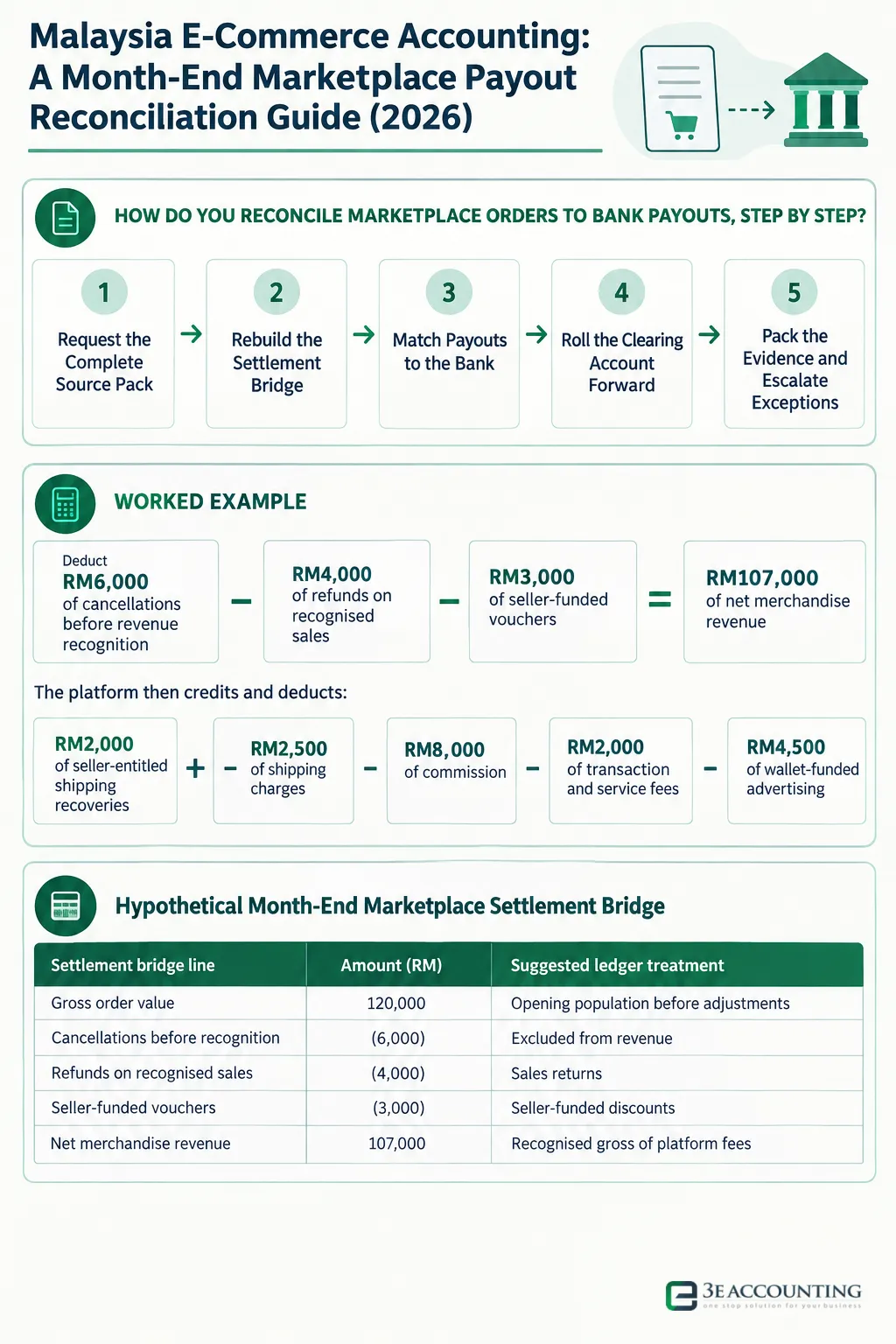
Collect complete source files first, then rebuild the settlement bridge, match payouts to the bank, roll the clearing account forward, and finish with an evidenced exception list.
Completeness comes before arithmetic. A reconciliation can add up perfectly and still be wrong because a settlement export is missing. Online seller bookkeeping in Malaysia is only as reliable as the exports behind it, so the steps below begin with files and end with exceptions.
Step 1: Request the Complete Source Pack
Ask for, per store and currency: the complete order-item report, the transaction-level wallet ledger, the settlement or payout export, and the refund, return and cancellation report. Add wallet opening and closing statements, bank statements, advertising invoices and campaign transaction reports, top-up records, platform fee documents, platform-issued e-Invoices, and any credit, debit or refund notes.
Treat this as a suggested request list rather than a guarantee, because platforms do not all provide the same files. Prefer original, unedited CSV or XLSX exports with identifiers retained as text. Keep bank CSV alongside the statement PDF. For e-Invoices, request validated structured data such as XML or JSON. Retain readable copies and validation references. Retain whatever the seller dashboard supplies rather than force a format. Set an internal document cutoff early in the month, and request the following month's transactions through the first payout covering the closing balance. Screenshots are supporting evidence, never the primary ledger input.
Step 2: Rebuild the Settlement Bridge
Move from gross order value to net settlement movement, classifying each line against the mapping in Table 1. Separate lines that adjust revenue from lines that are pure deductions, and keep card-funded advertising out of the bridge.
Step 3: Match Payouts to the Bank
Tie every payout identifier in the settlement export to a credit in the bank statement. Investigate in both directions: cash received without a payout, and payouts never received.
Step 4: Roll the Clearing Account Forward
Opening balance plus net settlement movement, less bank receipts, equals the closing balance. Support the closing figure with order or settlement-batch detail and expected settlement dates, then test the receipts that clear it next month.
Step 5: Pack the Evidence and Escalate Exceptions
The monthly pack should carry the clearing roll-forward, payout-to-bank matching, subsequent-receipt testing and an aged exception list. Investigate every unexplained difference, starting with the larger and recurring items. Materiality sets an investigation priority, not permission to ignore the rest.
What Does a Fully Reconciled Marketplace Month Look Like?
In one fully hypothetical month, RM120,000 of gross orders becomes a RM92,000 settlement movement and an RM85,000 bank receipt, with the RM22,000 difference explained as a supported closing receivable.
Every figure in this section is hypothetical and illustrative only. It is not a client case, not a typical result, and not a documented reconciliation of any seller. It simply shows how the arithmetic behaves when all three legs tie.
Start with RM120,000 of gross order value. Deduct RM6,000 of cancellations before revenue recognition, RM4,000 of refunds on recognised sales and RM3,000 of seller-funded vouchers, leaving RM107,000 of net merchandise revenue. The platform then credits RM2,000 of seller-entitled shipping recoveries and deducts RM2,500 of shipping charges, RM8,000 of commission, RM2,000 of transaction and service fees, and RM4,500 of wallet-funded advertising. The expense figures are illustrative invoice totals that include any applicable non-recoverable service tax; they assume no statutory rate.
The net settlement movement is RM92,000, but the bank need not receive RM92,000 that month. With an opening marketplace receivable of RM15,000 and RM22,000 outstanding at month-end, bank receipts are RM85,000: RM15,000 plus RM92,000, less RM22,000. Support the closing RM22,000 with order or settlement-batch detail, expected settlement dates and subsequent receipts. A receipt next month clears the receivable; it is not next month's sale.
One judgement to state plainly: revenue and cost cutoff depend on your terms and the accounting framework you apply. For a straightforward goods seller, delivery or customer acceptance evidence is normally the more relevant anchor than a paid-but-unfulfilled order – an interpretation, not a universal rule.
Hypothetical Month-End Marketplace Settlement Bridge
| Settlement bridge line | Amount (RM) | Suggested ledger treatment |
|---|---|---|
| Gross order value | 120,000 | Opening population before adjustments |
| Cancellations before recognition | (6,000) | Excluded from revenue |
| Refunds on recognised sales | (4,000) | Sales returns |
| Seller-funded vouchers | (3,000) | Seller-funded discounts |
| Net merchandise revenue | 107,000 | Recognised gross of platform fees |
| Seller-entitled shipping recoveries | 2,000 | Credited to shipping recoveries |
| Shipping charges | (2,500) | Shipping expense |
| Commission | (8,000) | Platform fee expense |
| Transaction and service fees | (2,000) | Platform fee expense |
| Wallet-funded advertising | (4,500) | Advertising expense |
| Net settlement movement | 92,000 | Movement through the clearing account |
Illustrative Marketplace Receivable Roll-Forward
| Clearing account roll-forward | Amount (RM) |
|---|---|
| Opening marketplace receivable | 15,000 |
| Add: net settlement movement | 92,000 |
| Less: bank receipts | (85,000) |
| Closing marketplace receivable | 22,000 |
How Do Marketplace Seller e-Invoices Fit into Month-End Reconciliation?
HASiL gives the platform two separate document roles: a self-billed e-Invoice covering the merchant's sales through the platform, and the platform's own e-Invoice for charges imposed on the merchant. Neither document equals the net bank payout.
Rules first, because they change by version. As checked on 21 October 2026, the guidance on HASiL's e-Invoice page lists the e-Invoice Guideline Version 4.8 alongside the e-Invoice Specific Guideline Version 4.9, published on 7 September 2026, which replaces Specific Guideline Version 4.8. Re-check the current guideline and your platform's own documentation before you rely on any workflow described here.
Under the Specific Guideline's e-commerce platform arrangements (sections 14.5.2 to 14.5.5), a platform must issue a self-billed e-Invoice to a merchant or service provider for transactions concluded on the platform. The merchant or service provider is the supplier; the platform assumes the buyer role for self-billing. The guideline also states that a self-billed e-Invoice does not by itself change the transaction's commercial nature or liability. This is an e-Invoice regulatory statement. It is not a conclusion on:
- revenue recognition;
- principal-versus-agent status;
- service tax; or
- contractual liability.
Platform charges are a separate stream. The Specific Guideline distinguishes self-billed documents issued to merchants (section 14.5) from the platform's own e-Invoices for charges imposed on the merchant (section 14.6). Commission and advertising are therefore ordinarily supported by the platform's supplier-issued e-Invoice, not a self-billed document. Confirm the issuing legal entity, document type and coverage inside your own seller account.
Buyer-facing documents follow their own allocation. For platform sales, the arrangements let the e-commerce platform provider assume the supplier role to facilitate an e-Invoice when the purchaser requests one, or issue a receipt where none is requested (section 14.4.2). The merchant should not duplicate that revenue by issuing another e-Invoice for the same platform transaction. The seller still records its underlying sales, discounts, returns and fees, with the documents linked. Direct website and other off-platform sales need their own assessment under your implementation date, exemption status and transaction rules; selling through a marketplace settles none of those.
In the pack, reconcile the self-billed document to the merchant transactions and adjustments it covers – never to the bank payout. Neither the self-billed sales document nor the platform's fee e-Invoice should be assumed to equal the net deposit. Check that your company's registered name, registration number and tax identification number (TIN) are correct on the documents.
Adjustments have their own document logic. Malaysia's MyInvois documentation defines a self-billed refund note as confirming a refund of the buyer's payment. It defines a self-billed credit note as reducing the value of an earlier e-Invoice. That reduction does not involve returning money to the buyer. The two are not interchangeable: match the adjustment document to the original document type and the actual refund flow, and do not infer it from a wallet movement alone.
Finally, do not assume identical dashboards. Each marketplace platform implements issuance, download formats and adjustment workflows differently, and platform-specific screens were not verified for this article. Confirm the issuer, document type and coverage in your own seller centre before month-end.
Which Reconciliation Exceptions Should You Investigate First?
Completeness first: the recurring problem patterns are missing exports, refunds booked in the wrong month, misclassified voucher funding, and document mismatches or duplicates.
The patterns below are where experienced practitioners look first. None of them needs special software – only the discipline to check coverage before totals, and to keep every difference on an aged list until it is resolved.
Balances labelled as timing deserve their own test. Split pending amounts, balances available for withdrawal, payouts in transit, and genuine reserves or disputes. Each needs evidence, and an old balance should not wear the timing label indefinitely. Where a trail is genuinely missing, escalate early: your corporate services provider can chase the platform, or you can reach our team through our contact page.
1. Missing or Partial Settlement Exports
Compare opening and closing wallet balances, export coverage and payout identifiers against the bank. Obtain the missing file or the platform's full transaction history before sign-off. A balanced spreadsheet proves nothing if a week of settlements is absent.
2. Refunds Dated After the Sale
Link every adjustment to its original order. Distinguish a genuinely later return from evidence that an obligation already existed at the previous reporting date. Assess any provision or prior-period correction under your framework; do not automatically reopen the sales month, and do not blindly expense everything in the payout month.
3. Voucher Funding and Shipping Entitlement
Separate seller-funded discounts from platform-funded subsidies and trace any reimbursement due. Do not post every promotion as advertising. Before accepting a classification, verify who funds each voucher and who is entitled to each shipping amount.
4. Document Mismatches and Duplicates
For e-Invoice mismatches, compare the transactions covered with the order ledger, not the bank payout. For fee-invoice mismatches, reconcile taxable charges, service tax, credits and wallet deductions. Send document errors back to the platform through its correction process, and never overwrite a validated document to force agreement. Control duplicate exports with transaction identifiers, and check card-funded advertising against the card account to prevent double posting.
Conclusion
Marketplace payout reconciliation is a control, not a bookkeeping chore. Gross sales, deductions, e-Invoice documents and bank receipts must tie to one underlying set of transactions every month. Start with complete source files, map every settlement line to its own account, and let a clearing balance absorb – and explain – the timing.
The e-Invoice layer adds document discipline on top, and the rules move: HASiL's Specific Guideline stood at Version 4.9 on 21 October 2026, so re-check before each close.
3E Accounting Malaysia is a Malaysia-based Corporate Services Provider helping local and international sellers. It helps structure clearing accounts, run month-end reconciliations and align e-Invoice documentation. The 3E Accounting International Network supports this work across more than 110 countries. When Malaysia e-commerce accounting starts to strain your close, our team can build a process that scales with your stores.
Get Your Marketplace Books Ready Before the Next Payout
We can set up clearing accounts, run the monthly reconciliation and keep your HASiL e-Invoice documents aligned with your order ledger.
Frequently Asked Questions
No. The payout is a settlement amount, not revenue. Recognise gross merchandise revenue, post each deduction to its own account, and let a marketplace clearing balance absorb timing differences. The bank entry clears the receivable; it does not create sales.
Under HASiL's e-commerce platform arrangements (Specific Guideline Version 4.9, checked 21 October 2026), the platform facilitates buyer-facing documents and may issue a self-billed e-Invoice to the merchant for platform transactions. Charges imposed on the merchant appear on the platform's own e-Invoice. Confirm the issuer, document type and coverage in your seller account.
Link the adjustment to its original order. Distinguish a genuinely later return from evidence that the obligation already existed at the previous reporting date, then assess any provision or prior-period correction under your framework. Do not automatically expense everything in the payout month.
Usually yes, where the seller funds the voucher: it generally reduces the transaction price. Platform-funded subsidies do not automatically reduce your revenue, and any reimbursement due should be traced. Classification depends on the promotion terms and the transaction evidence.
A practical list: the order-item report, transaction-level wallet ledger, settlement or payout export, refund and cancellation report, bank statements, advertising invoices, platform fee documents and platform-issued e-Invoices with adjustment notes. Prefer original CSV or XLSX exports and validated structured e-Invoice data where available.

Abigail Yu
Director
Abigail Yu oversees executive leadership at 3E Accounting Group, leading operations, IT solutions, public relations, and digital marketing to drive business success. She holds an honors degree in Communication and New Media from the National University of Singapore and is highly skilled in crisis management, financial communication, and corporate communications.