



Liberalisation of the Services Sector in Malaysia
Malaysia, in its pursuit of becoming a high-income, knowledge-driven economy, has steadily advanced the liberalisation of its services sector. Through a combination of unilateral reforms and regional trade agreements, the country has opened its markets to greater participation and innovation.
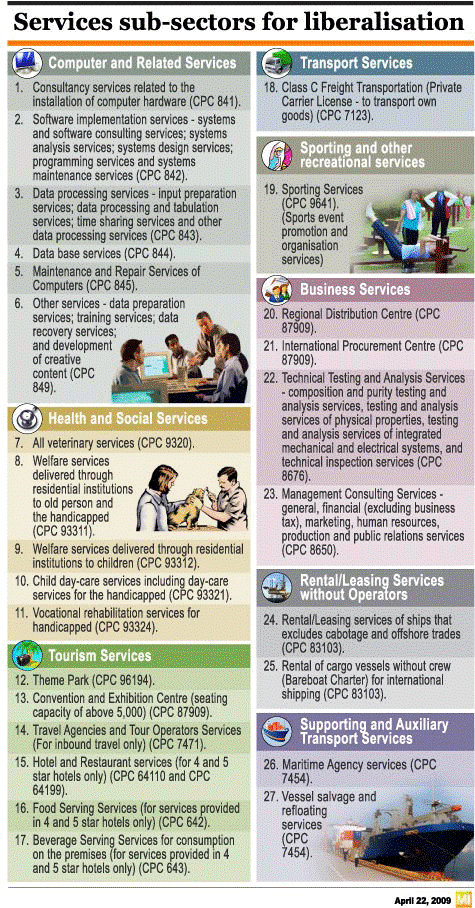
A key milestone came in 2012, when 27 service sub-sectors were liberalised to encourage foreign investment, enhance competitiveness, and support high-value-added growth. These initiatives underscore Malaysia’s long-term vision of positioning itself as a dynamic hub for business and investment in the region.
Key Dimensions of Malaysia’s Service Sector Liberalisation
1. Trade and Multilateral Commitments
Malaysia remains an active participant in the World Trade Organisation (WTO) and continues to advance service sector liberalisation through regional frameworks such as the ASEAN Framework Agreement on Services (AFAS). These commitments aim to deepen market access and promote regional integration.
2. Strategic Government Initiatives
To strengthen competitiveness and global readiness, the Malaysian government has implemented targeted strategies to enhance the capabilities of domestic service providers and encourage service exports in high-growth sectors.
3. Sectoral Impact and Readiness
The impact of liberalisation has varied across industries. While sectors like tourism, private education, and healthcare have effectively leveraged new opportunities, others continue to face challenges in adapting to increased competition and regulatory complexity.
4. Liberalisation of Professional Services Following the 2012 announcement to open 27 service sub-sectors, including professional services, many firms became aware of the reform but struggled to fully implement it. Studies highlight gaps in understanding and readiness among providers facing foreign entrants.
5. Industry Examples
- Construction: As part of Malaysia’s AFAS commitments, the construction sector moved toward full liberalisation in 2015, enabling reciprocal market access for local and foreign players.
- Financial Services: The government has progressively increased the issuance of licenses and expanded operational flexibility for foreign banks and insurers to foster competition and innovation.
6. Government Support Mechanisms
Recognising the challenges of liberalisation, the government continues to provide incentives, capacity-building programs, and regulatory support to help local service providers adapt and remain competitive in an open market environment.
Key Liberalisation Initiatives and Their Impact on Malaysia’s Services Sector
New Economic Model (NEM):
As part of the NEM, the Malaysian government positioned professional services as a core driver of economic transformation, focusing on enhancing competitiveness and global integration.
2012 Liberalisation Announcement:
In 2012, the government liberalised 27 service sub-sectors to attract foreign investment and expertise, aiming to boost productivity and elevate Malaysia’s global standing.
Removal of Bumiputera Equity Quotas (2009):
A significant milestone came with the elimination of the 30% Bumiputera equity requirement in selected service sub-sectors, marking a shift toward a more open and investor-friendly environment.
ASEAN Framework Agreement on Services (AFAS):
Under the AFAS, Malaysia has strengthened its regional commitments by implementing Mutual Recognition Agreements (MRAs), facilitating greater mobility for professionals such as engineers and architects across ASEAN.
Free Trade Agreements (FTAs):
Malaysia’s participation in FTAs with nations such as Australia, New Zealand, and Japan has accelerated services liberalisation, with commitments that often exceed those under the WTO’s General Agreement on Trade in Services (GATS).
Impact and Challenges of Liberalisation
Benefits
- Enhanced competition and efficiency: Market liberalisation has driven local firms to innovate and improve operational efficiency.
- Improved service quality: Increased competition provides consumers with more choices and better-quality services.
- Attraction of investment and skilled talent: Liberalisation has encouraged inflows of FDI and skilled professionals, enriching the domestic talent pool.
- Expanded market access: Reciprocal market openings abroad have enabled Malaysian firms to compete internationally.
- Acceleration of innovation and technology adoption: Greater openness fosters faster integration of technology, particularly in digital and professional service sectors.
Challenges
- Increased competitive pressure: Smaller domestic firms face tougher competition from established multinational players.
- Varying readiness levels: Some sectors and professionals remain underprepared for full liberalisation.
- Service trade deficits: Malaysia continues to record deficits in key modern services, including intellectual property and professional services.
- Uneven liberalisation across sub-sectors: Restrictions persist in specific modes of service delivery, particularly the “movement of natural persons.”
- Balancing openness with national priorities: Policymakers must reconcile liberalisation efforts with the preservation of strategic interests and Bumiputera participation.
Future Outlook
Malaysia has made commendable progress in opening its services sector, but further collaboration between the government, industry bodies, and private stakeholders is crucial. Continued emphasis on policy refinement, capacity building, and digital transformation will help local providers enhance competitiveness and fully capitalise on the benefits of a liberalised market.
(source: Malaysian Investment Development Authority)